Default Mode Network (DMN): Definition, Brain Regions, and What Neuroscience Research Shows

Table of Contents

Introduction

In the quest to understand the human brain, neuroscience has increasingly shifted its focus from studying isolated brain regions to examining large-scale, interconnected brain networks. 
 
This network-based approach recognizes that complex cognitive functions emerge from the coordinated activity of multiple, spatially distributed brain areas working in concert. A foundational concept in this field is the Default Mode Network (DMN), a major brain network that has reshaped our understanding of the brain’s intrinsic activity. 
 
This article provides a comprehensive, research-based explanation of the DMN, clarifying how it is defined, studied, and interpreted in modern neuroscience. It is important to state clearly that this article explains the scientific understanding of the DMN only. It does not provide medical, psychological, or therapeutic advice, nor does it imply that the DMN is associated with pathology, therapy, or enhancement.

What Is the Default Mode Network?

The Default Mode Network is a large-scale brain network of interacting brain regions whose activity is highly correlated with each other and distinct from other networks in the brain. The DMN is most active when an individual is not focused on the outside world and the brain is at wakeful rest, such as during daydreaming, mind-wandering, or quietly reflecting. 
 
The term “default” was coined by neurologist Marcus E. Raichle and his colleagues in 2001 because this network appears to represent a baseline or default state of brain function that is suspended during specific, attention-demanding, goal-directed tasks .
 
In neuroscience, the term “resting-state” does not imply that the brain is idle or inactive. On the contrary, the brain is always active, consuming a significant amount of the body’s energy even without a specific task. 
 
“Resting-state” refers to the experimental condition in which participants are instructed to simply lie quietly in a scanner, with their eyes open or closed, and not engage in any specific external task. It is during this state that the characteristic pattern of DMN activity is most prominent and can be reliably measured using functional brain imaging techniques.
 

Discovery and Historical Development of the DMN

 
The discovery of the DMN was an unexpected and serendipitous finding that emerged from early brain imaging studies using Positron Emission Tomography (PET). Researchers consistently observed that a specific set of brain regions decreased their activity when participants transitioned from a passive resting state to performing a novel, goal-oriented task. 
 
While initially treated as noise or a baseline to be subtracted, the consistency of this phenomenon across different tasks and laboratories suggested it was a genuine and organized property of brain function.
 
Dr. Marcus Raichle’s lab at Washington University in St. Louis was pivotal in characterizing this network. A meta-analysis of nine PET studies published in 1997 by his colleague Gordon Shulman first formally identified this consistent pattern of task-induced deactivations . The concept was further solidified by independent research from groups led by Jeffrey Binder at the Medical College of Wisconsin and Bernard Mazoyer in France .
 
In their seminal 2001 paper, Raichle and colleagues proposed that these deactivations were not just a passive consequence of engaging in a task, but rather represented the suspension of an organized, baseline mode of brain function—the “default mode” . The advent of resting-state functional connectivity analysis with functional Magnetic Resonance Imaging (fMRI) revolutionized the study of the DMN. 
 
In 2003, Michael Greicius and his colleagues demonstrated that the same brain regions that were deactivated during tasks showed highly correlated spontaneous activity during rest, confirming that the DMN is a cohesive, intrinsically connected network . This discovery opened the door for the widespread investigation of the brain’s intrinsic network architecture in both healthy and clinical populations.

Brain Regions Associated With the Default Mode Network

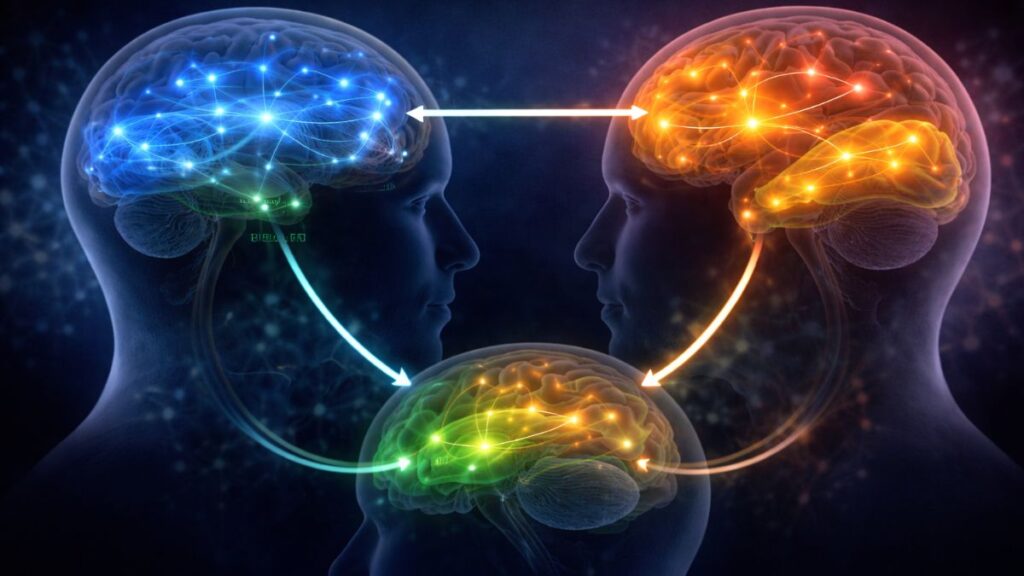
Conceptual illustration showing interactions between the Default Mode Network and other major brain networks
Illustration showing the dynamic relationship between the Default Mode Network, task-positive networks, and the salience network, highlighting large-scale brain network interactions.
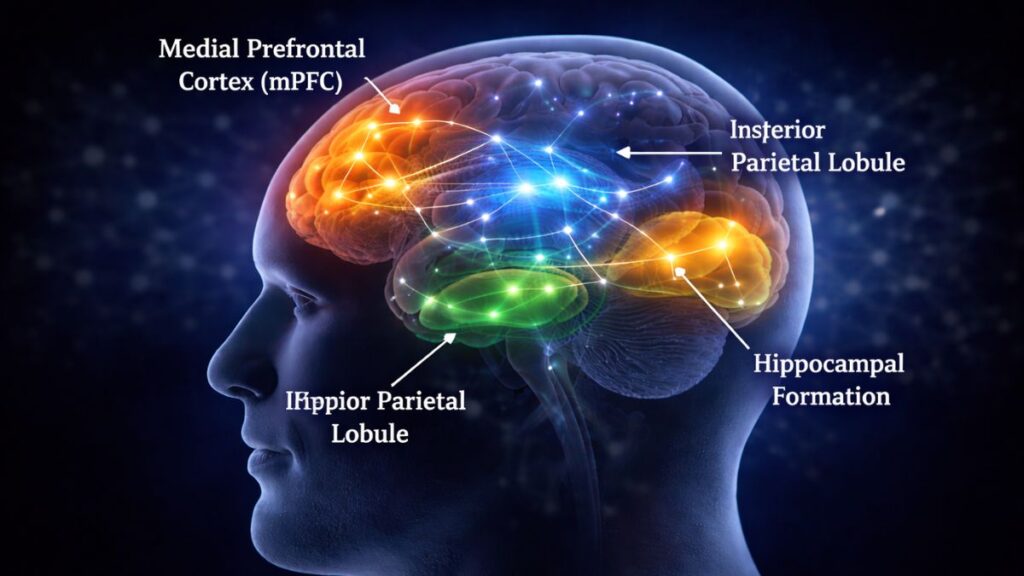
The DMN is composed of several core brain regions, or hubs, that are functionally connected. These hubs are located primarily in the medial and lateral surfaces of the cerebral cortex and are bilaterally symmetrical. The main components include:
 
Brain Region
High-Level Functional Association
Medial Prefrontal Cortex (mPFC)
Involved in self-referential processing, thinking about the future, and understanding the mental states of others (theory of mind).
Posterior Cingulate Cortex (PCC)
A central hub of the DMN, highly active and connected. It is involved in autobiographical memory retrieval and internally directed cognition.
Precuneus
Located adjacent to the PCC, this region is associated with visuospatial imagery, self-awareness, and episodic memory retrieval.
Inferior Parietal Lobule (IPL)
Contributes to memory retrieval, attention, and understanding language and mathematical concepts.
Hippocampal Formation
Plays a crucial contextual role, particularly in accessing and retrieving autobiographical and episodic memories.
 
It is crucial to avoid over-attributing specific functions to these regions in isolation. The functions associated with the DMN emerge from the complex interactions and coordinated activity among these interconnected hubs.
 

How the DMN Is Studied in Neuroscience Research

 
Researchers use several advanced techniques to study the DMN and other brain networks. The primary methods include:
 
Functional MRI (fMRI): This non-invasive imaging technique measures brain activity by detecting changes in blood flow. The Blood-Oxygen-Level-Dependent (BOLD) signal is an indirect measure of neural activity. During resting-state fMRI scans, researchers capture the spontaneous, low-frequency fluctuations in the BOLD signal.
 
Resting-State Functional Connectivity (rsFC): This is the most common analysis method for studying the DMN. By analyzing the fMRI data collected during rest, researchers can identify which brain regions show correlated patterns of activity over time. Regions whose activity patterns rise and fall in synchrony are considered functionally connected. This technique allows researchers to map the entire DMN and measure the strength of its internal connections.
 
Network Modeling Approaches: More advanced computational methods, such as graph theory and dynamic causal modeling, are used to understand the topological properties of brain networks and the directional influences between different network nodes. These models help researchers understand how information flows through the DMN and how it interacts with other networks.
 
It is important to acknowledge the limitations of these imaging methods. fMRI has relatively low temporal resolution and provides an indirect measure of neural activity. Furthermore, the BOLD signal can be affected by physiological factors like breathing and heart rate. The interpretation of functional connectivity as a direct reflection of neural communication is also a subject of ongoing research and refinement.
 

What the Default Mode Network Is Associated With

 
Research has linked DMN activity to a variety of internally focused cognitive processes. It is critical to interpret these findings as associations and correlations, not necessarily as direct causation. The DMN is consistently engaged during:
 
Self-Referential Cognition: Thinking about oneself, one’s personal traits, and one’s emotional state.
 
Mind-Wandering: The spontaneous, unconstrained stream of thoughts, memories, and images that occurs when the mind is not focused on an external task.
 
Autobiographical Memory: Recalling personal past events and experiences.
 
Episodic Memory: The memory of specific events in time, including their context.
 
Internal Narrative Processing: Constructing a coherent story of one’s life and experiences.
 
Thinking about the Future: Imagining and planning for future events.
 
Social Cognition: Thinking about the thoughts, feelings, and intentions of other people (theory of mind).
 
In a comprehensive 2023 review, Vinod Menon proposed that a unifying function of the DMN is to integrate and broadcast memory, language, and semantic representations to create a coherent “internal narrative” that is central to our sense of self .
 

What the Default Mode Network Is NOT

 
As the DMN has gained popularity, its role has often been misinterpreted and oversimplified in popular media and wellness circles. It is essential to clarify what the DMN is not, based on current scientific understanding:
 
It is NOT a “self center.”: While the DMN is involved in self-referential thought, the concept of “self” is a complex, multifaceted construct that involves numerous brain systems, not just one network.
 
It is NOT inherently “good” or “bad.”: The DMN is a fundamental component of normal brain function. Its activity is not inherently positive or negative. The context and content of the thoughts associated with its activity determine its valence.
 
It is NOT a “consciousness switch.”: The DMN is active during wakeful consciousness and its activity is altered in different states of consciousness, such as deep sleep, but it is not the sole generator or switch for consciousness itself.
 
It is NOT a spiritual or mystical structure: While contemplative practices can influence brain network activity, the DMN is a neuroscientific construct studied with empirical methods. Attributing mystical or spiritual properties to it falls outside the scope of scientific evidence.

The DMN and Other Brain Networks

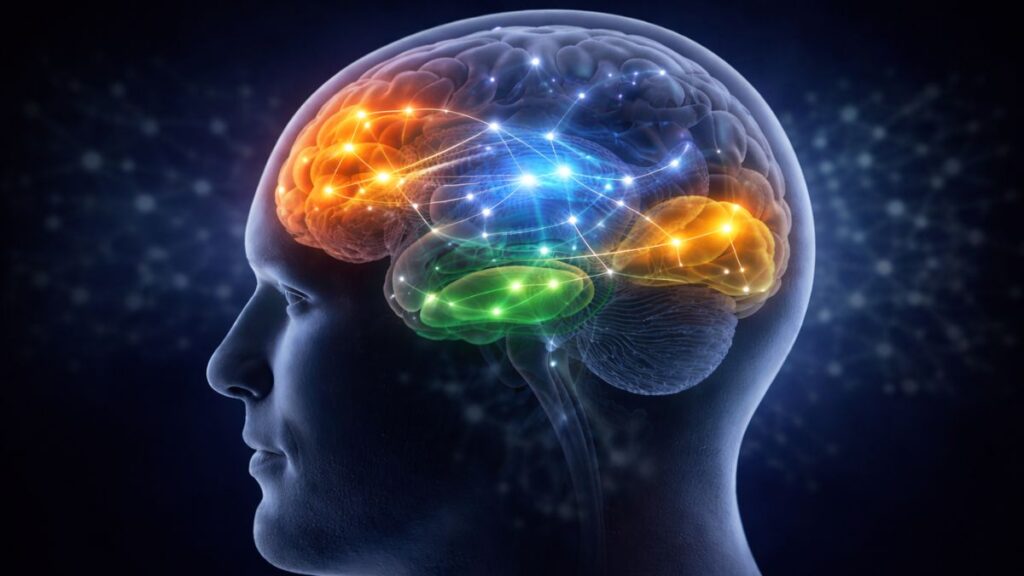
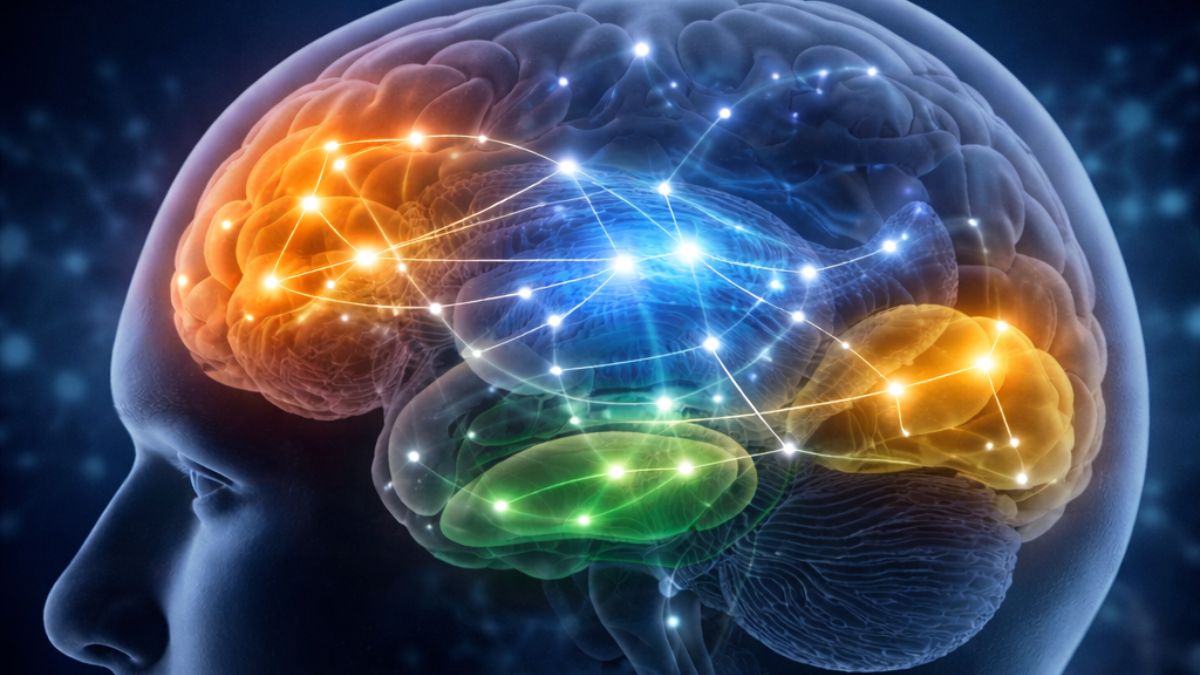
Abstract brain illustration representing functional connectivity patterns associated with the Default Mode Network
The brain’s network architecture is dynamic, and the DMN does not operate in isolation. It has a particularly important relationship with other major networks:


Task-Positive Networks (TPNs): This is a broad category of networks, including the Central Executive Network (CEN) and the Dorsal Attention Network (DAN), that are consistently activated during externally focused, attention-demanding tasks. Seminal work by Michael Fox and Marcus Raichle showed that the DMN and TPNs are typically anticorrelated . When the DMN is active, TPNs are suppressed, and vice versa. This push-pull relationship is thought to be fundamental for switching between internal and external modes of attention.


Salience Network (SN): This network, with key hubs in the anterior insula and anterior cingulate cortex, plays a crucial role in detecting behaviorally relevant stimuli and switching between the DMN and the CEN. Seminal research by Vinod Menon and Lucina Uddin suggests the SN acts as a dynamic “switchboard,” disengaging the DMN and engaging the CEN when an important external event requires attention .
This dynamic interaction and balance between networks are essential for flexible and adaptive cognitive function.
 

The Default Mode Network in Research Contexts

 
Alterations in DMN connectivity and activity have been observed in a wide range of research studies, providing insights into the neural basis of various conditions. It is crucial to frame these findings as research observations only, not as diagnostic markers or clinical tools.
 
Mental Health Studies: Research has shown altered DMN patterns in individuals with depression, schizophrenia, and anxiety disorders. For example, some studies have observed hyperconnectivity within the DMN in depression, which may be associated with increased rumination . In schizophrenia, aberrant DMN connectivity has been linked to functional pathology .
 
Neurodevelopment and Aging Research: The DMN undergoes significant maturation throughout childhood and adolescence, becoming more integrated over time . In older adults, research has shown age-related declines in the DMN’s ability to deactivate during tasks, which may be related to cognitive changes in aging . Altered DMN connectivity is also a major focus of research in neurodegenerative disorders like Alzheimer’s disease .
 
Sleep and Consciousness Research: The DMN’s activity changes dramatically across different states of consciousness. Studies have shown that the network’s integrity is significantly reduced during deep sleep compared to wakefulness, reflecting the change in conscious state .
These correlational findings are helping researchers build models of brain function and dysfunction, but they do not provide a basis for therapeutic or diagnostic claims in a clinical setting.

Common Misconceptions in Popular Media

Conceptual illustration highlighting major brain regions commonly associated with the Default Mode Network
The DMN has become a popular topic in online articles, social media, and self-help literature, often leading to significant misconceptions. As science communicator Dr. Irena O’Brien notes, the DMN is frequently and inaccurately portrayed as a villain—”the problem,” “overactive,” or the direct “cause of anxiety” .
 
Oversimplified Explanations: The most common oversimplification is calling the DMN the “rest network.” This ignores the fact that the DMN can be engaged in intense internal work, such as anxious rumination or creative problem-solving.
 
Metaphorical Misuse: The DMN is often used as a catch-all explanation for any negative internal experience. Blaming the DMN for anxiety or lack of focus is a metaphorical misuse that ignores the whole-system nature of these states. Anxiety, for example, involves threat detection systems, physiological arousal, and prior learning, not just one brain network.
 
Media Exaggeration: Headlines often claim that you can or should “shut off” or “silence” your DMN. This is both impossible and undesirable. The DMN is integral to core human cognitive functions like memory, planning, and social understanding. The goal is not to eliminate it, but to foster the flexibility to shift between brain states appropriately.
 
This nuance matters because misinterpreting the DMN can lead to unhelpful and even counterproductive self-help strategies. Rather than seeing the DMN as an enemy to be defeated, a more accurate scientific perspective is to view it as a fundamental component of the mind’s internal landscape, whose activity reflects the overall state of the nervous system.
 

Limitations and Open Questions in DMN Research

 
Despite two decades of intensive research, there are still many limitations and open questions in the study of the DMN:
 
Individual Variability: There are significant individual differences in the DMN’s connectivity and activity. Understanding what drives this variability and how it relates to personality, cognitive style, and genetics is an active area of research.
 
Methodological Constraints: The reliance on fMRI and the interpretation of resting-state data come with inherent limitations. The relationship between BOLD signal correlations and underlying neural communication is complex and not fully understood.
 
Ongoing Debates: The precise functions of the DMN and its constituent parts are still debated. The causal role of the DMN in the cognitive processes associated with it remains a key question that requires more advanced methods to answer.
 
What Neuroscience Still Does Not Know: Many fundamental questions remain. How exactly does the DMN contribute to consciousness? How does its dysfunction contribute to the symptoms of mental illness? How does it interact with other brain systems to produce the rich tapestry of human thought? These are among the many exciting frontiers for future research.

Frequently Asked Questions.

What is the Default Mode Network in simple terms?

The Default Mode Network is a large-scale brain network that is most active when the mind is not focused on an external task. It supports internally directed processes such as self-reflection, memory recall, imagining the future, and constructing an internal narrative. It represents a baseline mode of brain activity rather than a state of inactivity.

The Default Mode Network is active during wakeful rest but becomes less active during attention-demanding, goal-directed tasks. When a person focuses on external stimuli, other brain networks increase in activity while the Default Mode Network is temporarily suppressed. This dynamic switching is a normal and essential feature of healthy brain function.

Research has observed altered Default Mode Network connectivity in studies involving conditions such as depression, anxiety, schizophrenia, and neurodegenerative disorders. These findings are correlational and research-based only. The Default Mode Network is not a diagnostic marker and should not be interpreted as a cause of mental illness.

No. The Default Mode Network cannot be turned off, eliminated, or permanently silenced. It is a fundamental component of normal brain function and plays a crucial role in memory, self-concept, and social cognition. Scientific research focuses on understanding how the brain flexibly shifts between networks, not on suppressing the Default Mode Network.

The Default Mode Network is frequently oversimplified or misrepresented in popular articles as the “source of negative thoughts” or something that should be shut down. These interpretations ignore the complexity of brain networks and the fact that the Default Mode Network supports many essential cognitive functions. Neuroscience research emphasizes balance and flexibility between networks rather than labeling one as harmful.

Conclusion

The Default Mode Network represents a paradigm shift in neuroscience, moving the field from a purely task-focused view of brain function to an appreciation of the brain’s rich and organized intrinsic activity. It is a scientific model that helps us understand the neural basis of our internal world—the constant stream of thoughts, memories, and projections that constitute a large part of our conscious experience. 

As a central hub for self-referential cognition, autobiographical memory, and future thinking, the DMN is fundamental to our sense of self and our ability to navigate the social world.
 
It is essential to interpret the science of the DMN with caution and precision, avoiding the oversimplifications and misinterpretations common in popular media. The DMN is not a flaw to be fixed, but a feature of the human brain to be understood. As research continues to evolve, our understanding of this fascinating network and its role in health and disease will undoubtedly become even more nuanced, further illuminating the intricate workings of the human mind.

Sources & Further Reading


⚠️ Educational & Medical Disclaimer

This article is for educational and informational purposes only and does not constitute medical, psychological, or therapeutic advice. The information provided is a summary of scientific research and should not be used for self-diagnosis or as a substitute for professional consultation. 

Neuroscience research findings are complex and continually evolving, and they should be interpreted within professional and clinical contexts. If you have concerns about your mental or physical health, please consult a qualified healthcare professional.

Share this post :

Facebook
Twitter
LinkedIn
Pinterest
Popular Product