How Long Do Magic Mushrooms Stay in the Body? Metabolism, Half-Life, and Drug Testing

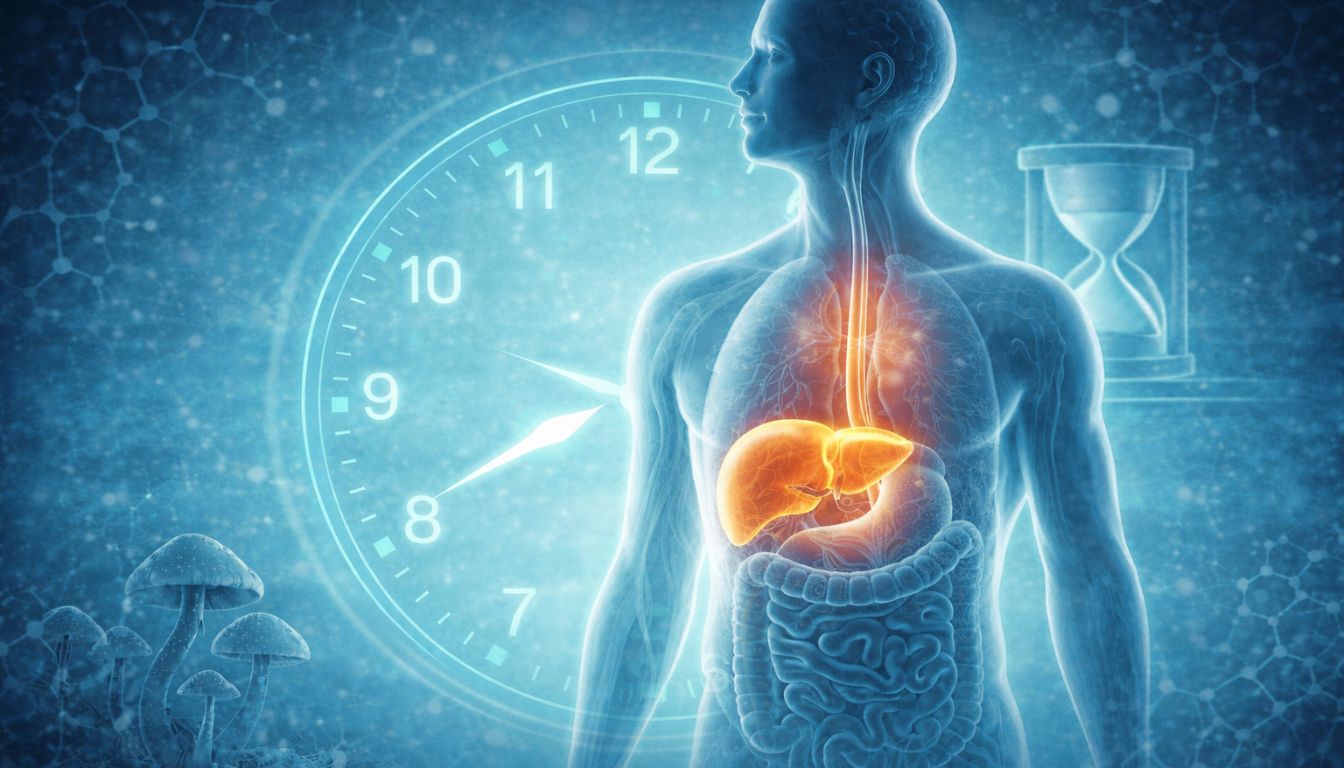
Medical illustration showing how long magic mushrooms stay in the body, highlighting the liver, digestive system, and time-based metabolism process.

Table of Contents

Public interest in psychedelic substances, including psilocybin-containing mushrooms, has grown significantly, leading to common questions about their interaction with the human body. A frequent query is, “How long do magic mushrooms stay in your system?” 
 
This question often stems from a desire to understand drug testing, personal health implications, or simple curiosity. However, the answer is far from straightforward and is fraught with misconceptions. 
 
The duration a substance remains detectable in the body is not a fixed timeline but a complex interplay of metabolic processes, individual physiology, and the specifics of testing methodologies. This article aims to demystify these concepts by explaining the scientific principles of pharmacology and toxicology related to psilocybin. 
 
It is crucial to understand that this information is provided for educational purposes only and does not constitute medical, legal, or practical advice. The goal is to foster a scientifically grounded understanding of metabolism and detection, not to provide guidance on predicting or influencing any individual’s test results.
 

What Are “Magic Mushrooms” in Pharmacological Research?

 
The term “magic mushrooms” is a colloquialism for fungi that contain the psychoactive compounds psilocybin and psilocin. While over 200 species of mushrooms have been identified to contain these compounds, scientific and clinical research does not focus on the mushrooms themselves, which can vary widely in potency and composition. 
 
Instead, pharmacological studies concentrate on the specific, isolated compounds: psilocybin (4-phosphoryloxy-N,N-dimethyltryptamine) and its active metabolite, psilocin (4-hydroxy-N,N-dimethyltryptamine). 
 
By studying these pure substances, researchers can ensure standardized dosing and accurately measure their effects and metabolic pathways, which is impossible when using the raw fungal material. Therefore, any scientific discussion about how “magic mushrooms” are processed by the body is, in fact, a discussion about the pharmacokinetics of psilocybin and psilocin.
 

Active Compounds and Metabolism (Psilocybin & Psilocin)
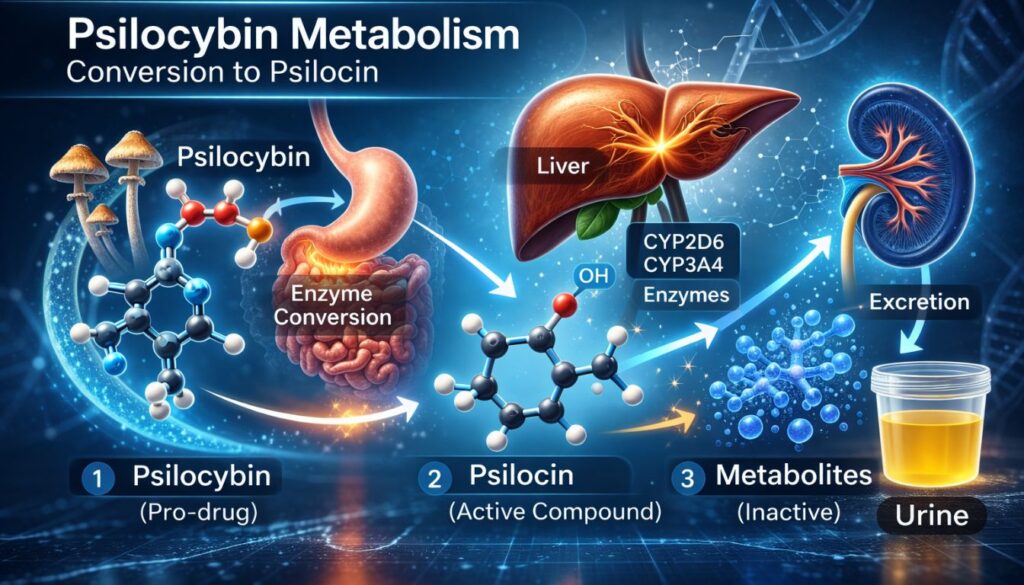
 
When psilocybin is ingested, it functions primarily as a pro-drug, meaning it is a biologically inactive compound that the body must convert into an active form. This metabolic conversion happens rapidly after consumption. An enzyme called alkaline phosphatase, which is present in the gut and liver, dephosphorylates psilocybin, removing a phosphate group to transform it into psilocin [1]. Psilocin is the primary psychoactive compound responsible for the hallucinogenic effects associated with these mushrooms, acting as an agonist or partial agonist at serotonin receptors in the brain, particularly the 5-HT2A subtype [2].
The liver plays a central role in the subsequent metabolism of psilocin. It is broken down by a family of enzymes known as cytochrome P450 (CYP), specifically CYP2D6 and CYP3A4, with additional contributions from monoamine oxidase (MAO) [3]. This process, known as biotransformation, converts psilocin into inactive metabolites that can be more easily eliminated from the body. The main urinary metabolite identified in forensic and clinical toxicology is psilocin-O-glucuronide, which is formed by attaching a glucuronic acid molecule to psilocin, making it more water-soluble for excretion by the kidneys [2]. Understanding this metabolic pathway is fundamental to interpreting how the body processes these compounds and why detection methods focus on specific metabolites.
Infographic explaining how long magic mushrooms stay in the body by showing psilocybin conversion to psilocin and liver metabolism before excretion.

Understanding Half-Life in Pharmacology

In pharmacology, the concept of half-life is a critical measure of how long a drug remains in the body. It is defined as the time it takes for the concentration of a substance in the bloodstream (plasma) to be reduced by exactly one-half (50%). For example, if a drug has a half-life of 2 hours, its concentration will be halved every 2 hours. It is a common rule of thumb in pharmacokinetics that it takes approximately 5 to 6 half-lives for a substance to be considered effectively eliminated from the plasma.
It is essential to distinguish between metabolism and elimination. Metabolism refers to the chemical transformation of the drug into other compounds (metabolites), while elimination is the process of expelling the drug or its metabolites from the body, primarily through urine or feces. A drug’s half-life is a measure of its elimination rate, not just its metabolism.
Crucially, half-life is not equivalent to a detection window. The half-life of psilocin has been reported to be in the range of 1.5 to 4 hours, with one study citing an average of 3 hours [3] [4]. While this suggests that the active compound is cleared from the bloodstream relatively quickly (within approximately 15-24 hours), its metabolites may persist for longer. Drug tests are often designed to detect these more stable and abundant metabolites, not just the parent drug. Furthermore, half-life is an average derived from population studies and can vary significantly from person to person, making it an unreliable predictor for an individual’s detection time.

What Research Says About Detection and Testing
Drug testing is a complex field that relies on detecting the presence of specific parent drugs or their metabolites in biological samples. Most standard drug screening panels, such as the common 5-panel or 10-panel tests used in workplace or clinical settings, are designed to detect common substances of abuse like cannabinoids, opioids, cocaine, amphetamines, and benzodiazepines. Psilocybin and psilocin are not routinely included in these standard screens. Specialized tests are required to detect them, which are typically only ordered when there is a specific reason to suspect their use, such as in a forensic investigation or a clinical setting where hallucinogen use is relevant.
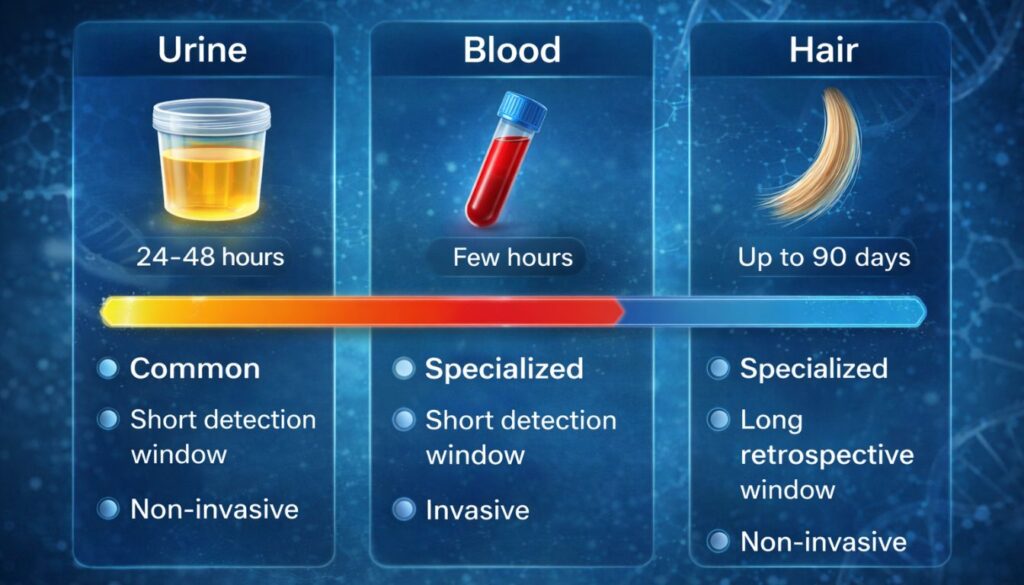
Comparison chart showing how long magic mushrooms stay in the body across urine, blood, and hair drug testing methods.

Urine Testing (High-Level Explanation)

Urine testing is the most common method for drug screening due to its non-invasive nature and relatively longer detection window compared to blood tests. These tests work by using antibodies to detect the presence of specific drug metabolites that are excreted by the kidneys. For psilocybin, urine tests are designed to identify psilocin or, more commonly, its major metabolite, psilocin-O-glucuronide [2]. While research is limited and variable, most scientific sources suggest that psilocin is typically detectable in urine for up to 24 to 48 hours after use [5]. However, this window can be influenced by numerous factors, and there is no standardized cutoff concentration for psilocin in routine testing, further complicating any prediction of detection.

Blood, Hair, and Other Testing Methods

Other testing methods exist, each with different characteristics and applications:
Blood Testing: Blood tests detect the parent drug and its active metabolites circulating in the bloodstream. Due to psilocin’s relatively short half-life, its detection window in blood is very short, often limited to a few hours after ingestion (potentially up to 12 hours). This method is more invasive and is typically used in clinical or emergency settings to determine acute intoxication rather than past use.
Hair Follicle Testing: Hair testing provides a much longer retrospective window of detection. As blood flows to the hair follicles, drug metabolites can be incorporated into the hair shaft. As hair grows, it creates a timeline of substance use. A standard 1.5-inch hair sample can theoretically detect use for up to 90 days (based on an average growth rate of 0.5 inches per month). While hair analysis for psilocin is possible and has been used in forensic contexts, it is a highly specialized and expensive test that is not used in routine screening [6].
Saliva Testing: Saliva testing offers a detection window similar to or slightly shorter than urine. It is becoming more common due to its non-invasive nature and the difficulty of adulteration. However, research on the detection of psilocin in saliva is still limited.
It is important to distinguish between the use of these tests in a research context, where the goal is to understand pharmacokinetics, and their use in a forensic or clinical context, where the goal is to determine compliance or diagnose intoxication. The thresholds, methods, and interpretation can differ significantly.

Why Detection Can Vary Between Individuals

The idea of a fixed detection window for any substance is a myth. The time psilocin and its metabolites remain detectable is subject to significant individual variability. Research has identified several factors that contribute to these differences:
Metabolic Rate: Individuals have different metabolic rates due to genetic factors. Polymorphisms (variations) in the genes that code for CYP enzymes, such as CYP2D6, can lead to individuals being poor, intermediate, extensive, or ultrarapid metabolizers. A person who metabolizes psilocin more slowly may have a longer detection window than a rapid metabolizer [7].
Body Composition and Chemistry: Factors such as body mass index (BMI), body fat percentage, hydration levels, and overall health can influence how a drug is distributed and eliminated. Liver and kidney function are particularly critical, as these organs are central to metabolism and excretion.
Dosage and Frequency of Use: A higher dose or more frequent use will result in higher concentrations of the drug and its metabolites in the body, potentially extending the detection window.
Mushroom Species and Potency: The concentration of psilocybin and psilocin can vary dramatically between different species and even different batches of mushrooms, making the actual dose ingested highly uncertain.
Study Design Limitations: Much of the available data comes from studies with small sample sizes, specific populations (e.g., healthy young adults), and controlled doses of synthetic psilocybin. These findings may not be generalizable to the broader population using mushrooms of unknown potency in uncontrolled settings.
These variables make it impossible to provide a precise, one-size-fits-all answer to how long psilocybin will remain detectable.

Research Limitations and Common Misconceptions

The scientific literature on psilocybin pharmacokinetics, while growing, remains limited compared to that for more common drugs. This has led to the proliferation of myths and speculative claims online. One of the most persistent misconceptions is the idea of a fixed detection time. As discussed, this is biologically implausible. Any website or source that claims to provide a guaranteed timeline for passing a drug test should be viewed with extreme skepticism.
Another misconception is that outcomes are predictable or can be easily manipulated. The variability in both human physiology and the composition of mushrooms themselves makes any prediction for a specific individual unreliable. The internet is filled with anecdotal reports and unverified methods for “clearing” substances from the system, none of which are supported by scientific evidence. Relying on such information is risky and unfounded. The current body of research allows us to understand the principles of how psilocybin is processed, but it does not provide a formula for predicting individual outcomes.
Banner displaying psychedelic research audiobooks including titles by William A. Richards, Rick Strassman, Albert Hofmann, and others, with Audible logo and call to action to start listening.
Research-focused audiobooks exploring psychedelic science and consciousness studies.
1️⃣ How long do magic mushrooms stay in the body?

Psilocybin is rapidly converted into psilocin after ingestion. The active compound, psilocin, has a half-life of roughly 1.5 to 4 hours. While the psychoactive effects typically subside within 6–8 hours, metabolites may remain detectable for up to 24–48 hours in urine, depending on individual factors.

Psilocybin itself has a short half-life because it is quickly converted into psilocin. Psilocin’s average half-life is approximately 3 hours, meaning it takes several hours for blood levels to decline significantly.

Psilocybin is converted into psilocin by alkaline phosphatase enzymes. Psilocin is then metabolized in the liver primarily by cytochrome P450 enzymes (CYP2D6 and CYP3A4) and monoamine oxidase (MAO), producing inactive metabolites excreted in urine.

Research suggests psilocin or its metabolites may be detectable in urine for approximately 24 to 48 hours after ingestion. However, detection windows vary widely depending on metabolism, dose, and testing sensitivity.

No. Psilocybin and psilocin are not included in standard 5-panel or 10-panel drug tests. Specialized testing is required to detect them

Psilocin has a short detection window in blood, typically limited to several hours after ingestion. Blood testing is usually used to detect recent use or acute intoxication rather than past exposure.

In specialized forensic settings, psilocin can potentially be detected in hair samples. However, hair testing for psilocybin is rare, expensive, and not used in routine screening.

Yes. Higher doses generally result in higher concentrations of psilocin and metabolites, which may extend detection windows. However, individual metabolism still plays a major role.

Detection time varies due to differences in liver enzyme activity, genetic factors (such as CYP2D6 polymorphisms), body composition, hydration levels, and overall health.

Body composition may influence distribution and metabolism, but it is only one of many factors. Liver function and enzyme activity are typically more influential than body weight alone.

Metabolism refers to the chemical transformation of psilocybin into psilocin and further metabolites. Elimination refers to the process of removing these substances from the body, primarily through urine.

No. The psychoactive effects usually last 4–8 hours, but metabolites may remain detectable after subjective effects have ended.

Hydration influences urine production but does not significantly alter the metabolic breakdown of psilocin. Drug metabolism is primarily governed by liver enzyme activity.

No. There is no scientifically supported, guaranteed timeline. Detection windows are estimates based on population averages and cannot predict individual outcomes.

Compared to more commonly tested substances, psilocybin has historically received less forensic focus. Many pharmacokinetic studies involve small sample sizes and controlled doses, limiting generalizability.

Conclusion

In summary, the question of how long magic mushrooms stay in the body is best answered through the lens of pharmacology. After ingestion, psilocybin is rapidly converted to the active compound psilocin, which has a relatively short half-life of a few hours. However, drug tests often detect its inactive metabolites, which may be present in urine for approximately 24 to 48 hours, though this is highly variable. Psilocybin is not included in standard drug screens, and specialized tests are required for its detection.
What science can explain is the metabolic pathway, the concept of half-life, and the factors that contribute to variability. What remains uncertain is the precise detection window for any given individual under any given circumstance. This uncertainty underscores the importance of prioritizing conceptual understanding over practical assumptions. The most accurate and responsible conclusion from the available evidence is that detection windows are variable and cannot be predicted with certainty. This educational framework, grounded in evidence-based interpretation, is essential for navigating a topic often clouded by misinformation.

[Internal link: Magic Mushrooms and the Brain: What Science Actually Shows]


[Internal link: Side Effects, Risks, and Long-Term Effects of Psychedelic Mushrooms]


[Internal link: Contraindications & Interactions Hub]


[Internal link: Glossary: Key Terms in Psychedelic Science]

Sources & Further Reading

1.Passie, T., Seifert, J., Schneider, U., & Emrich, H. M. (2002). The pharmacology of psilocybin. Addiction biology, 7(4), 357-364. (source)
2.Dinis-Oliveira, R. J. (2017). Metabolism of psilocybin and psilocin: clinical and forensic toxicological relevance. Drug metabolism reviews, 49(1), 84-91. (source)
3.Meshkat, S., et al. (2025). Pharmacokinetics of Psilocybin: A Systematic Review. Pharmaceutics, 17(4), 411. (source)
4.Brown, R. T., et al. (2017). Pharmacokinetics of escalating doses of oral psilocybin in healthy adults. Clinical pharmacokinetics, 56(12), 1543-1554. (source)
5.Medical News Today. (n.d.). How long do ‘magic mushrooms’ stay in your system? (source)
6.Gotoh, Y., et al. (2021). Sensitive quantitative analysis of psilocin and psilocybin in hair samples from suspected users and their distribution in seized hallucinogenic mushrooms. Forensic Toxicology, 39(1), 195-205. (source)
7.Vizeli, P., & Liechti, M. E. (2021). Genetic influence of CYP2D6 on pharmacokinetics and subjective effects of LSD in a pooled analysis. Scientific reports, 11(1), 1-8. (source)

Educational & Medical Disclaimer

This article is for educational and informational purposes only and does not constitute medical, legal, or drug testing advice. The information provided is based on scientific research and is intended to explain pharmacological concepts. The metabolism and detection of any substance, including psilocybin, vary significantly between individuals and cannot be predicted. The detection windows mentioned are estimates based on limited research and are not guaranteed for any individual. Readers should consult with a qualified healthcare professional for any medical concerns and a qualified legal professional for legal advice. Do not rely on this information to predict or attempt to influence the outcome of a drug test.

Share this post :

Facebook
Twitter
LinkedIn
Pinterest
Popular Product