Introduction
In the quest to understand the human brain, neuroscience has increasingly shifted its focus from studying isolated brain regions to examining large-scale, interconnected brain networks.
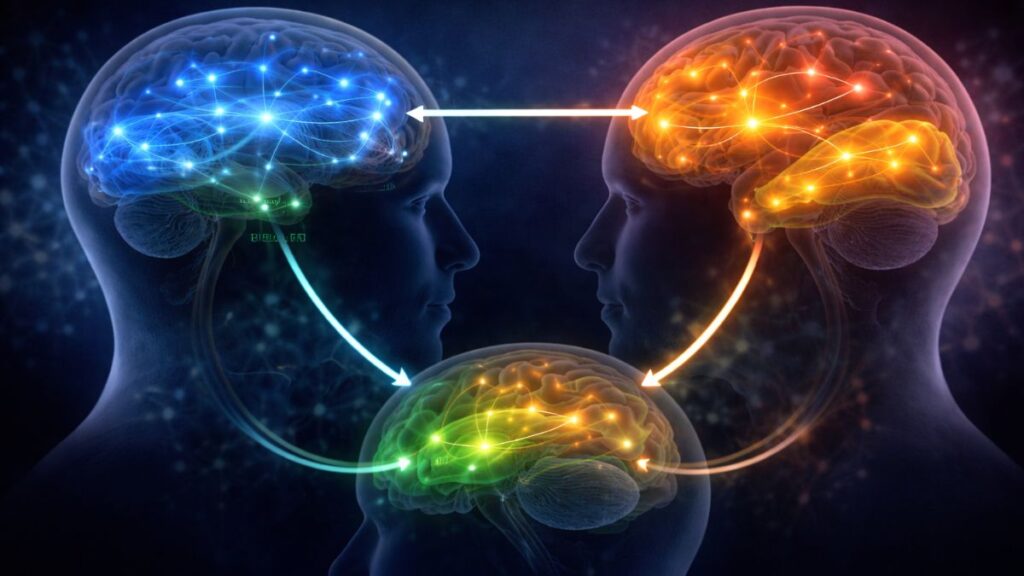
This network-based approach recognizes that complex cognitive functions emerge from the coordinated activity of multiple, spatially distributed brain areas working in concert. A foundational concept in this field is the Default Mode Network (DMN), a major brain network that has reshaped our understanding of the brain’s intrinsic activity.
This article provides a comprehensive, research-based explanation of the DMN, clarifying how it is defined, studied, and interpreted in modern neuroscience. It is important to state clearly that this article explains the scientific understanding of the DMN only. It does not provide medical, psychological, or therapeutic advice, nor does it imply that the DMN is associated with pathology, therapy, or enhancement.
What Is the Default Mode Network?
The Default Mode Network is a large-scale brain network of interacting brain regions whose activity is highly correlated with each other and distinct from other networks in the brain. The DMN is most active when an individual is not focused on the outside world and the brain is at wakeful rest, such as during daydreaming, mind-wandering, or quietly reflecting.
The term “default” was coined by neurologist Marcus E. Raichle and his colleagues in 2001 because this network appears to represent a baseline or default state of brain function that is suspended during specific, attention-demanding, goal-directed tasks .
In neuroscience, the term “resting-state” does not imply that the brain is idle or inactive. On the contrary, the brain is always active, consuming a significant amount of the body’s energy even without a specific task.
“Resting-state” refers to the experimental condition in which participants are instructed to simply lie quietly in a scanner, with their eyes open or closed, and not engage in any specific external task. It is during this state that the characteristic pattern of DMN activity is most prominent and can be reliably measured using functional brain imaging techniques.
Discovery and Historical Development of the DMN
The discovery of the DMN was an unexpected and serendipitous finding that emerged from early brain imaging studies using Positron Emission Tomography (PET). Researchers consistently observed that a specific set of brain regions decreased their activity when participants transitioned from a passive resting state to performing a novel, goal-oriented task.
While initially treated as noise or a baseline to be subtracted, the consistency of this phenomenon across different tasks and laboratories suggested it was a genuine and organized property of brain function.
Dr. Marcus Raichle’s lab at Washington University in St. Louis was pivotal in characterizing this network. A meta-analysis of nine PET studies published in 1997 by his colleague Gordon Shulman first formally identified this consistent pattern of task-induced deactivations . The concept was further solidified by independent research from groups led by Jeffrey Binder at the Medical College of Wisconsin and Bernard Mazoyer in France .
In their seminal 2001 paper, Raichle and colleagues proposed that these deactivations were not just a passive consequence of engaging in a task, but rather represented the suspension of an organized, baseline mode of brain function—the “default mode” . The advent of resting-state functional connectivity analysis with functional Magnetic Resonance Imaging (fMRI) revolutionized the study of the DMN.
In 2003, Michael Greicius and his colleagues demonstrated that the same brain regions that were deactivated during tasks showed highly correlated spontaneous activity during rest, confirming that the DMN is a cohesive, intrinsically connected network . This discovery opened the door for the widespread investigation of the brain’s intrinsic network architecture in both healthy and clinical populations.
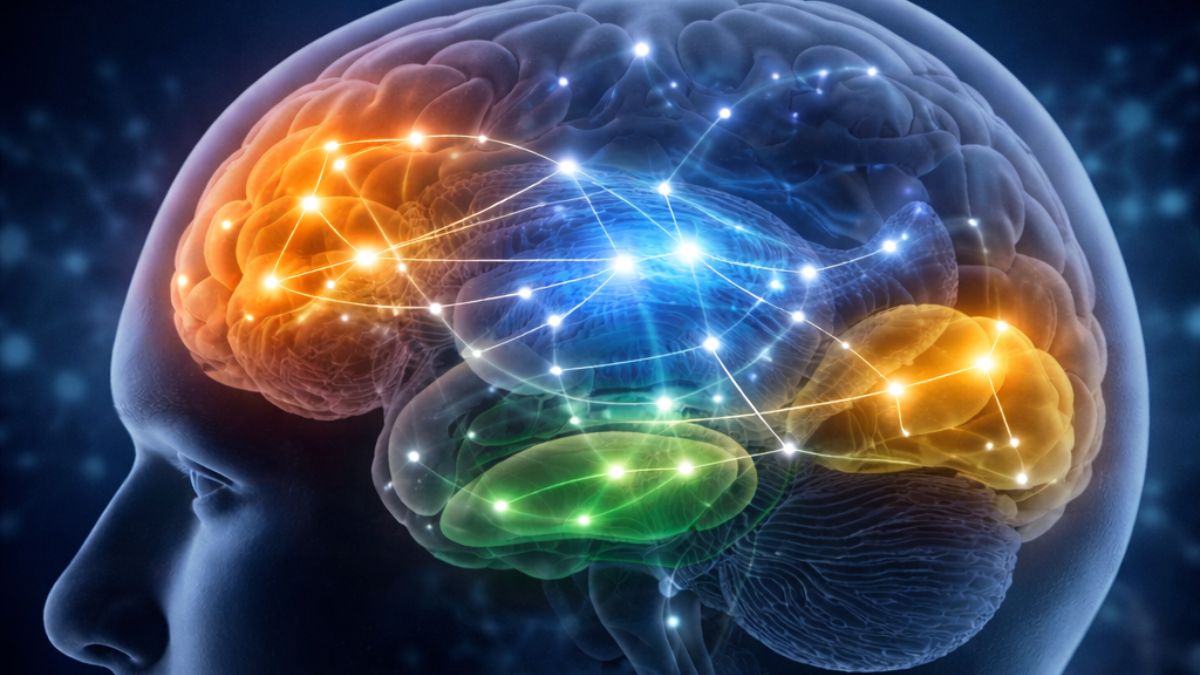
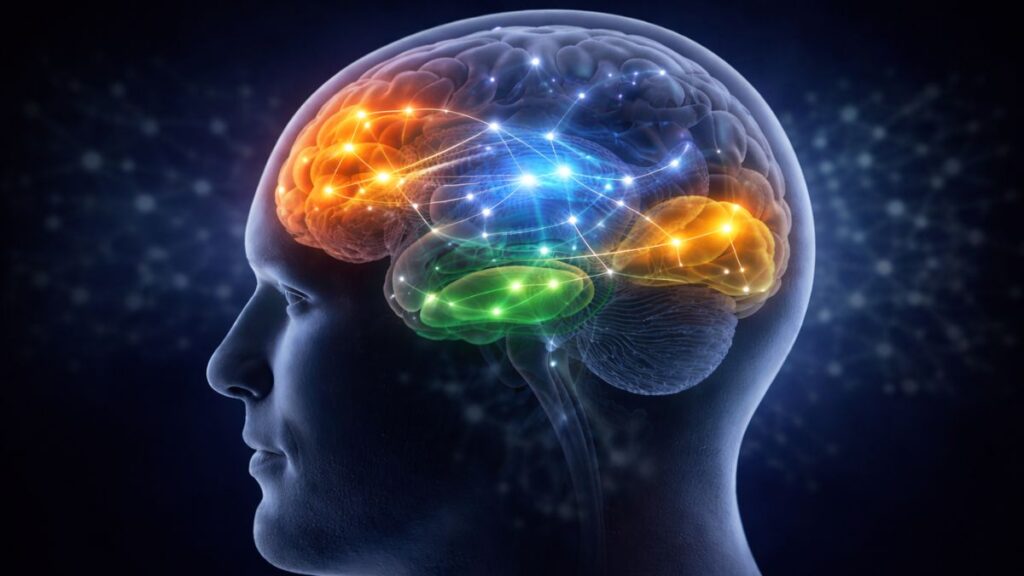
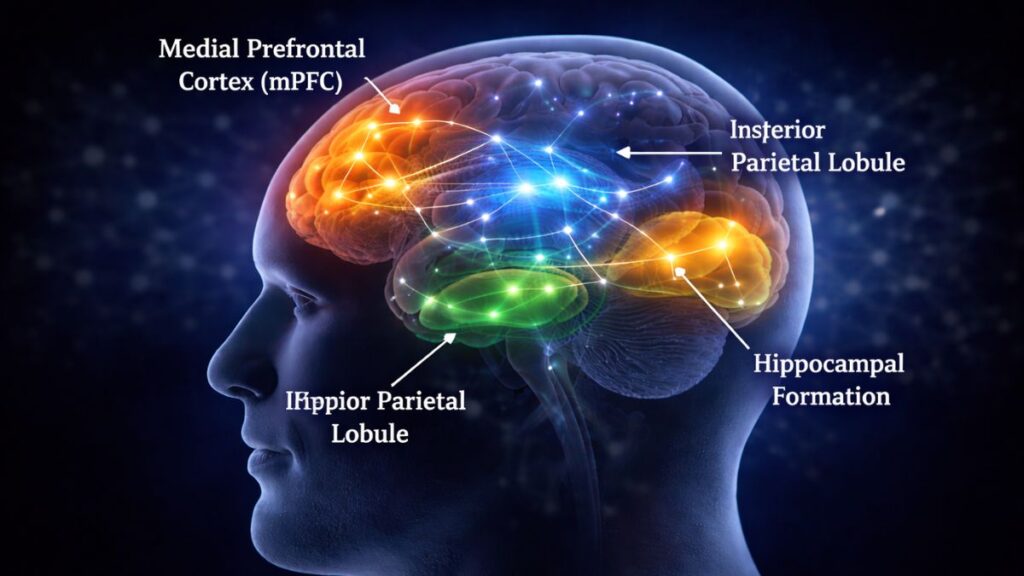
The DMN is composed of several core brain regions, or hubs, that are functionally connected. These hubs are located primarily in the medial and lateral surfaces of the cerebral cortex and are bilaterally symmetrical. The main components include:
Brain Region | High-Level Functional Association |
Medial Prefrontal Cortex (mPFC) | Involved in self-referential processing, thinking about the future, and understanding the mental states of others (theory of mind). |
Posterior Cingulate Cortex (PCC) | A central hub of the DMN, highly active and connected. It is involved in autobiographical memory retrieval and internally directed cognition. |
Precuneus | Located adjacent to the PCC, this region is associated with visuospatial imagery, self-awareness, and episodic memory retrieval. |
Inferior Parietal Lobule (IPL) | Contributes to memory retrieval, attention, and understanding language and mathematical concepts. |
Hippocampal Formation | Plays a crucial contextual role, particularly in accessing and retrieving autobiographical and episodic memories. |
It is crucial to avoid over-attributing specific functions to these regions in isolation. The functions associated with the DMN emerge from the complex interactions and coordinated activity among these interconnected hubs.
How the DMN Is Studied in Neuroscience Research
Researchers use several advanced techniques to study the DMN and other brain networks. The primary methods include:
•Functional MRI (fMRI): This non-invasive imaging technique measures brain activity by detecting changes in blood flow. The Blood-Oxygen-Level-Dependent (BOLD) signal is an indirect measure of neural activity. During resting-state fMRI scans, researchers capture the spontaneous, low-frequency fluctuations in the BOLD signal.
•Resting-State Functional Connectivity (rsFC): This is the most common analysis method for studying the DMN. By analyzing the fMRI data collected during rest, researchers can identify which brain regions show correlated patterns of activity over time. Regions whose activity patterns rise and fall in synchrony are considered functionally connected. This technique allows researchers to map the entire DMN and measure the strength of its internal connections.
•Network Modeling Approaches: More advanced computational methods, such as graph theory and dynamic causal modeling, are used to understand the topological properties of brain networks and the directional influences between different network nodes. These models help researchers understand how information flows through the DMN and how it interacts with other networks.
It is important to acknowledge the limitations of these imaging methods. fMRI has relatively low temporal resolution and provides an indirect measure of neural activity. Furthermore, the BOLD signal can be affected by physiological factors like breathing and heart rate. The interpretation of functional connectivity as a direct reflection of neural communication is also a subject of ongoing research and refinement.
What the Default Mode Network Is Associated With
Research has linked DMN activity to a variety of internally focused cognitive processes. It is critical to interpret these findings as associations and correlations, not necessarily as direct causation. The DMN is consistently engaged during:
•Self-Referential Cognition: Thinking about oneself, one’s personal traits, and one’s emotional state.
•Mind-Wandering: The spontaneous, unconstrained stream of thoughts, memories, and images that occurs when the mind is not focused on an external task.
•Autobiographical Memory: Recalling personal past events and experiences.
•Episodic Memory: The memory of specific events in time, including their context.
•Internal Narrative Processing: Constructing a coherent story of one’s life and experiences.
•Thinking about the Future: Imagining and planning for future events.
•Social Cognition: Thinking about the thoughts, feelings, and intentions of other people (theory of mind).
In a comprehensive 2023 review, Vinod Menon proposed that a unifying function of the DMN is to integrate and broadcast memory, language, and semantic representations to create a coherent “internal narrative” that is central to our sense of self .
What the Default Mode Network Is NOT
As the DMN has gained popularity, its role has often been misinterpreted and oversimplified in popular media and wellness circles. It is essential to clarify what the DMN is not, based on current scientific understanding:
•It is NOT a “self center.”: While the DMN is involved in self-referential thought, the concept of “self” is a complex, multifaceted construct that involves numerous brain systems, not just one network.
•It is NOT inherently “good” or “bad.”: The DMN is a fundamental component of normal brain function. Its activity is not inherently positive or negative. The context and content of the thoughts associated with its activity determine its valence.
•It is NOT a “consciousness switch.”: The DMN is active during wakeful consciousness and its activity is altered in different states of consciousness, such as deep sleep, but it is not the sole generator or switch for consciousness itself.
•It is NOT a spiritual or mystical structure: While contemplative practices can influence brain network activity, the DMN is a neuroscientific construct studied with empirical methods. Attributing mystical or spiritual properties to it falls outside the scope of scientific evidence.
 Educational & Medical Disclaimer