What “Types” Means in This Context
Species vs. Genus vs. “Strain”
High-Level Categories (Educational, Non-Identification)
Psilocybin-Containing Mushrooms (Conceptual Overview)
Other Psychoactive Mushrooms (e.g., Amanita species)
Why This Site Does Not Provide Identification or “Red Flag” Guidance
Commonly Discussed Genera (High-Level Only)
Truffles vs. Mushrooms (Conceptual Comparison)
Why Classification Matters (Safety and Science)
Variability, Uncertainty, and Limits of Current Research
Myths vs. Evidence
“Strain” Marketing vs. Formal Taxonomy
“All Blue-Bruising Mushrooms Are Psychedelic”
What does “types” of psychedelic mushrooms actually mean in scientific terms?
In scientific and mycological contexts, the word “types” when referring to psychedelic mushrooms is not a formal taxonomic rank. Instead, it serves as a general, informal term that points to the established scientific classification system known as taxonomy.
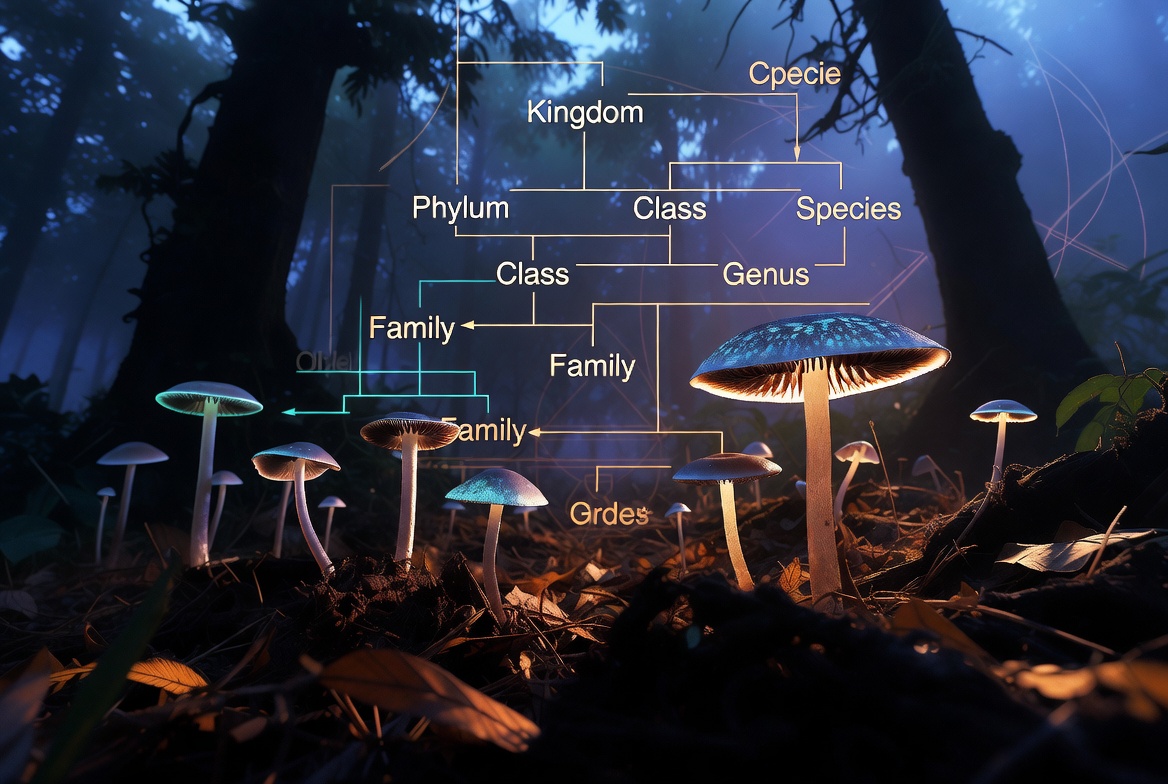
Fungi are organized in a hierarchical structure that begins at the broad Kingdom level and narrows down through Phylum, Class, Order, Family, Genus, and finally Species. For the purpose of this article, “types” primarily refers to the two most practical and precise levels: genus and species. These categories are based on genetic relationships, shared morphological features, and evolutionary history, allowing for clear and unambiguous identification.
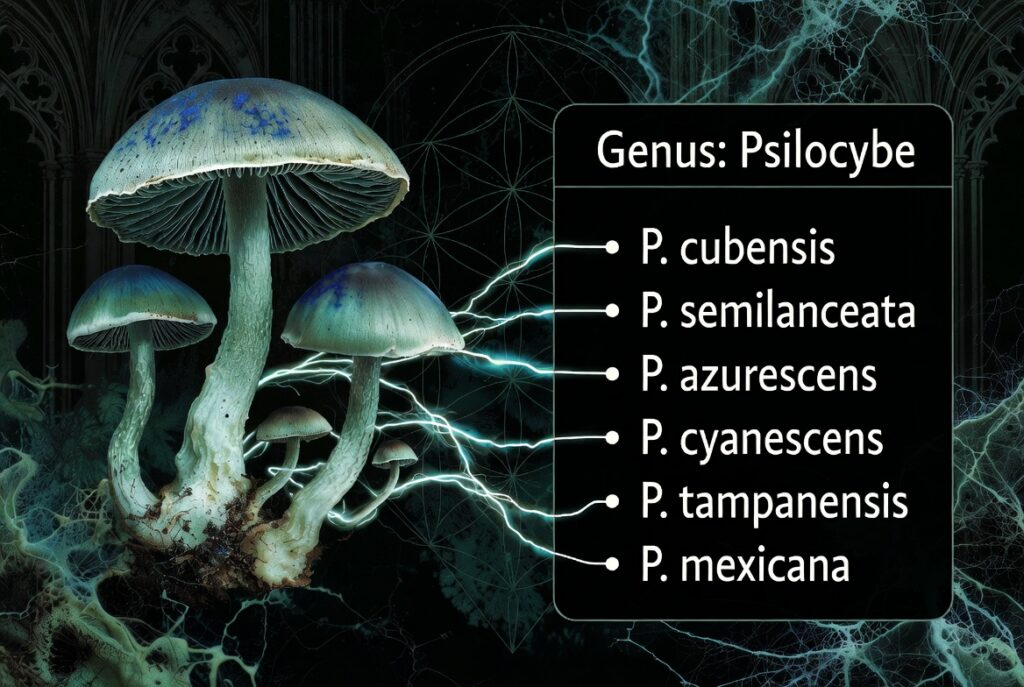
For example, Psilocybe is a genus, while Psilocybe cubensis is a specific species within that genus. This binomial naming system (genus + species) is the internationally accepted standard in biology. It provides consistency across research, medicine, and conservation efforts worldwide.
This scientific approach stands in sharp contrast to the casual language commonly used in online communities and commercial markets. Terms like “strains” (e.g., Golden Teacher, Penis Envy, B+) are not recognized in formal mycology. These are usually cultivated varieties of the same species — most often Psilocybe cubensis — that have been selectively bred for certain traits. While they may differ slightly in appearance or growth characteristics, they do not represent distinct scientific “types.”
Using precise taxonomic terminology helps reduce dangerous confusion, supports accurate research, and emphasizes the importance of proper identification. In short, when we discuss the “types” of psychedelic mushrooms on this site, we refer to the reliable framework of genus and species rather than marketing-driven or colloquial names. This science-first perspective is essential for both educational value and harm reduction.
What is the difference between genus, species, and “strain” when talking about psychedelic mushrooms?
Understanding the distinction between genus, species, and “strain” is fundamental to discussing psychedelic mushrooms accurately and safely.
- Genus: A genus is a taxonomic rank that groups together closely related species that share a common ancestor and key characteristics. It sits above species and below family. In the world of psychedelic fungi, Psilocybe is one of the most well-known genera. It contains many (but not all) species that produce psilocybin. Other relevant genera include Panaeolus, Pluteus, and Gymnopilus.
- Species: This is one of the most important and precise units in biological classification. A species consists of organisms that can interbreed and produce fertile offspring. The full scientific name always includes both the genus and the species epithet — for example, Psilocybe cubensis or Psilocybe semilanceata. Species-level identification is the standard for scientific communication because it refers to a specific, genetically distinct organism.
- “Strain”: In popular culture and commercial markets, the term “strain” is widely used but has almost no formal standing in mycology. In true microbiology, a strain refers to a genetically distinct subtype within a species. However, most “strains” marketed to enthusiasts (such as Golden Teacher, B+, or Penis Envy) are simply selectively cultivated varieties of the same species — usually Psilocybe cubensis. These variations may show differences in growth speed, cap color, or yield, but they are not separate species or scientifically recognized categories.
This marketing-driven terminology often creates a false impression of greater diversity and chemical differences than actually exist. In reality, the primary active compounds (psilocybin and psilocin) remain largely consistent across these cultivated varieties.
By sticking to the scientifically accepted terms of genus and species, we promote clarity, accuracy, and safety. Misunderstanding these concepts can lead to confusion about potency, identification, and risk — which is why formal taxonomy remains the gold standard in research and education.
Why does the article focus only on genus and species instead of popular strain names?
The article deliberately focuses on the scientifically valid categories of genus and species rather than popular “strain” names for several important reasons related to accuracy, safety, and educational integrity.
First, “strain” names such as Golden Teacher, B+, Penis Envy, or Albino A+ are not recognized in formal mycology or taxonomy. They are marketing terms created within subcultures and commercial spore/vendor markets. In most cases, these are simply different cultivated varieties of the same species — predominantly Psilocybe cubensis. While they may exhibit minor differences in appearance, growth rate, or yield under controlled conditions, they do not represent genetically distinct species or even officially recognized strains in the scientific sense.
Relying on these informal names creates confusion and can give a misleading impression that each “strain” has dramatically different chemical profiles or effects. In reality, research shows that the primary psychoactive compounds (psilocybin and psilocin) are generally consistent across varieties of the same species. Significant variation in potency is more often influenced by growing conditions, substrate, harvest time, and drying methods than by these marketed names.
By using only genus and species nomenclature, the article aligns with the international scientific standard. This approach eliminates ambiguity and supports a more responsible, evidence-based discussion. It also underscores a key safety message: precise identification at the species level is critical because many toxic mushrooms can look similar to psychoactive ones. Informal “strain” language does not provide the accuracy needed for safe understanding.
Ultimately, this science-first focus helps readers develop a clearer, more accurate mental framework about psychedelic fungi while avoiding the hype and potential misinformation that often surrounds commercial “strain” marketing.
Are all psychedelic mushrooms the same as psilocybin mushrooms?
No, not all psychedelic mushrooms are the same as psilocybin mushrooms. This is one of the most important distinctions in the study of psychoactive fungi.
The majority of well-known psychedelic mushrooms produce psilocybin and its active metabolite psilocin. These compounds interact primarily with serotonin receptors (especially 5-HT2A) in the brain, producing the classic alterations in perception, thought, and mood commonly associated with psychedelic experiences. These species are found across several genera, including Psilocybe, Panaeolus, Pluteus, and Gymnopilus.
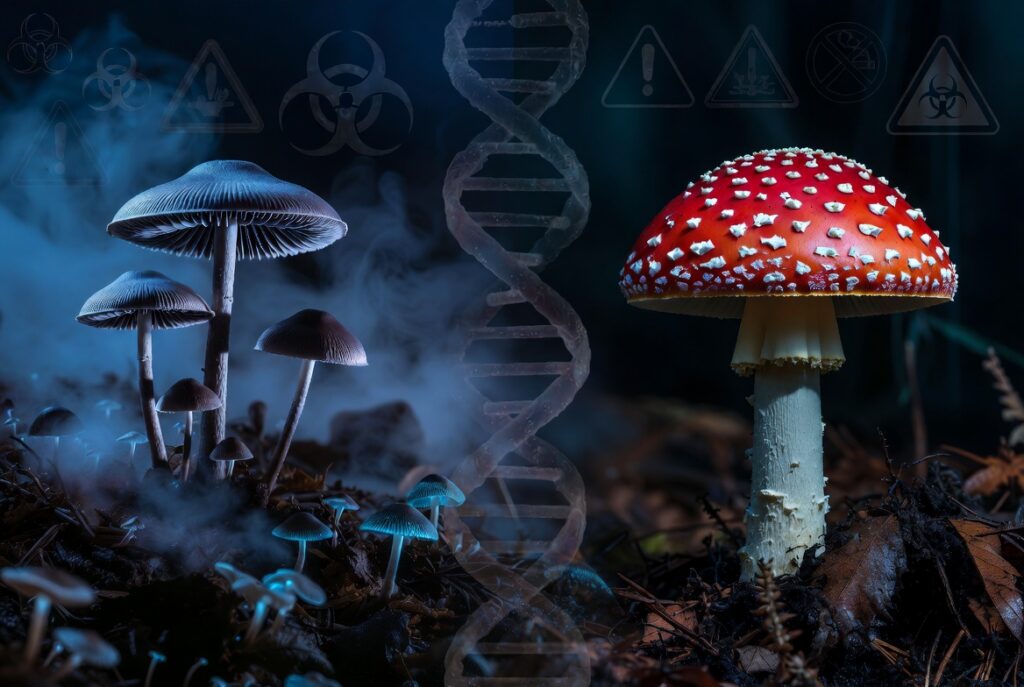
However, there are other psychoactive mushrooms that work through entirely different chemical mechanisms. The most prominent example is Amanita muscaria (the fly agaric mushroom). It does not contain psilocybin or psilocin at all. Instead, its primary compounds are ibotenic acid and muscimol, which act on the GABA-A receptor system — the same inhibitory neurotransmitter pathway influenced by alcohol and benzodiazepines. This produces a very different type of experience, with distinct effects and risk profiles.
This chemical and mechanistic diversity is why it is scientifically inaccurate and potentially dangerous to group all “psychedelic mushrooms” together. Their safety profiles, dosages, onset times, and potential toxicities differ significantly. For instance, while psilocybin mushrooms have a relatively low physiological toxicity, certain Amanita species can be highly toxic or even deadly if misidentified.
By clearly separating psilocybin-containing species from other psychoactive fungi like Amanita muscaria, we promote a more accurate and responsible understanding. Recognizing these fundamental differences is essential for both scientific research and harm reduction.
What makes Amanita muscaria different from psilocybin-containing mushrooms?
Amanita muscaria (commonly known as the fly agaric) is fundamentally different from psilocybin-containing mushrooms in its chemistry, mechanism of action, effects, and safety profile.
While most classic “magic mushrooms” produce psilocybin and psilocin, which act on serotonin (5-HT2A) receptors, Amanita muscaria contains ibotenic acid and muscimol. Ibotenic acid can convert to muscimol in the body, and muscimol acts as a potent agonist at GABA-A receptors — the primary inhibitory system in the brain. This mechanism is more comparable to the effects of alcohol, benzodiazepines, or certain sedatives than to serotonergic psychedelics like psilocybin.
Because of these differences, the subjective experience is markedly distinct. Psilocybin mushrooms typically produce visual distortions, profound changes in thinking, emotional openness, and a sense of connection. In contrast, Amanita muscaria tends to produce a more deliriant-like state that can include sedation, dissociation, vivid dreaming, and sometimes confusion or unpredictable effects.
From a safety perspective, the risks are also very different. Psilocybin mushrooms have an extremely low toxicity profile and are not considered physically dangerous in terms of overdose. Amanita muscaria, while rarely fatal, can cause significant nausea, vomiting, sweating, and in higher doses, more intense and potentially distressing neurological effects. It is also important to note that other species in the Amanita genus are highly toxic or deadly (such as the Death Cap), making accurate identification critical.
In short, Amanita muscaria represents an entirely different class of psychoactive fungus. Grouping it with psilocybin mushrooms under the broad label “psychedelic” is scientifically misleading and can create dangerous confusion for foragers and users alike.
Why doesn’t this website provide mushroom identification guides or “red flags”?
This website does not provide identification guides, photos for comparison, or simple “red flag” rules because misidentification of wild mushrooms can be fatal, and we prioritize safety and responsibility above all else.
Many psilocybin-containing mushrooms are small, brown, and nondescript, making them easy to confuse with deadly toxic species. For example, certain Galerina species contain the same deadly amatoxins found in the infamous Death Cap (Amanita phalloides) and frequently grow in the same habitats — sometimes even intertwined with psychoactive species. Visual characteristics such as color, shape, and size can vary significantly depending on environmental factors like substrate, weather, and geography.
There are no reliable universal “red flags” or shortcuts that amateurs can safely use. Even features commonly associated with psychoactive mushrooms, such as blue bruising, are not exclusive to them. Some toxic species can also exhibit blue or blue-green bruising, while not all psilocybin mushrooms bruise strongly.
Accurate mushroom identification requires expert-level knowledge, microscopic examination of spores and cellular structures, and often DNA analysis. Professional mycologists never rely on photographs or field guides alone for confirmation, especially with species that have life-threatening look-alikes.
By refusing to offer any identification assistance, this site avoids the risk of contributing to dangerous mistakes. The goal is education about scientific classification, taxonomy, and core concepts — not to encourage or enable foraging. Wild mushroom foraging for psychoactive species is inherently high-risk and strongly discouraged. For anyone interested in fungi, the safest and most responsible path is to study mycology through academic resources and never consume wild specimens without laboratory verification.
Which genera contain most psilocybin-producing mushroom species?
While hundreds of mushroom species are known to contain psilocybin, the vast majority are concentrated within a few key genera. The article highlights four primary ones at a high, conceptual level:
1. Psilocybe This is by far the most famous and species-rich genus of psilocybin-containing fungi. It contains well over 150 identified species. Following a major taxonomic reclassification, the genus Psilocybe is now defined to include only species that produce psilocybin and typically bruise blue. This makes it the central focus of most discussions about psychedelic mushrooms.
2. Panaeolus (often called “mottlegills”) This genus includes several potent psilocybin-producing species. They frequently grow in grassy areas and on dung. Because psilocybin production is not consistent across the entire genus, it can be particularly confusing for non-experts.
3. Pluteus Although the Pluteus genus is large and contains many edible wood-rotting species, a relatively small number of them produce psilocybin. Their presence within an otherwise edible genus further illustrates why assumptions based on genus alone can be dangerous.
4. Gymnopilus (known as “laughing gyms” or “specters”) These are typically orange to rusty-brown mushrooms that grow on wood. Several species in this genus produce psilocybin, but they are easily confused with toxic look-alikes, including deadly Galerina species.
It is important to emphasize that even within these genera, the diversity is vast, and the presence of toxic look-alikes is a constant concern. The article discusses these genera only at a high conceptual level without providing descriptive details that could be misused for identification. Accurate classification and confirmation in these groups ultimately rely on microscopic analysis and DNA methods rather than visual traits alone.
What are “magic truffles” and how do they differ from actual mushrooms?
“Magic truffles” is a common but somewhat misleading term. They are not true truffles (which belong to the genus Tuber and are culinary fungi). Instead, magic truffles are sclerotia — dense, hardened masses of fungal mycelium produced by certain psilocybin-containing mushroom species.
Key Biological Differences:
- Mushrooms (Fruiting Bodies): These are the reproductive structures of the fungus. They grow above ground, are relatively short-lived, and are responsible for producing and dispersing spores. You see them as the classic “mushroom” shape with a cap and stem.
- Sclerotia (“Truffles”): These are compact underground survival structures made of mycelium. They act as a food reserve, allowing the fungus to endure harsh conditions such as drought, extreme temperatures, or nutrient scarcity. When conditions improve, the sclerotium can germinate to grow new mycelium or produce regular fruiting bodies.
Only a few species in the Psilocybe genus are known to produce significant sclerotia, most notably Psilocybe tampanensis and Psilocybe mexicana. Although sclerotia and mushrooms are developmentally and structurally different, they contain the same primary psychoactive compounds — psilocybin and psilocin.
The term “magic truffles” became popular in regions where the sale of sclerotia was legally tolerated even when fresh mushrooms were restricted. Biologically, however, they are simply a different part of the same fungal organism. This distinction is important for understanding fungal life cycles and for clear scientific communication, but it does not change the chemical reality that both forms can produce similar psychedelic effects when consumed.
Is blue bruising a reliable way to identify psychedelic mushrooms?
No, blue bruising is not a reliable way to identify psychedelic mushrooms. This is a widespread and potentially dangerous myth.
The blue (or blue-green) bruising reaction occurs due to the oxidation of psilocybin and related compounds when the mushroom tissue is damaged. It is indeed a characteristic feature of many (but not all) psilocybin-producing species, particularly in the genus Psilocybe. However, it is far from a foolproof indicator.
Several non-psychoactive and even toxic mushroom species can also exhibit blue or blue-green bruising. For example, certain species in the genus Boletus bruise blue but contain no psilocybin. Relying on this single trait has led to serious misidentifications.
Furthermore, not every psilocybin-containing mushroom bruises strongly or at all. The intensity of bruising can vary based on the species, the age of the specimen, growing conditions, and how fresh the mushroom is. Some potent species show only faint or no visible bruising, while certain toxic look-alikes may show similar discoloration.
This is why mycologists never depend on bruising (or any single visual characteristic) for definitive identification. Proper identification requires a combination of macroscopic features, microscopic analysis of spores and gill structure, habitat data, and increasingly, DNA sequencing.
The belief that “if it bruises blue, it’s magic” is a classic example of “a little knowledge being dangerous.” In reality, accurate identification of wild mushrooms — especially small brown species — is extremely difficult and should only be attempted by highly trained experts. For safety reasons, this website strongly advises against foraging and does not provide any identification guidance.
Why is accurate taxonomic classification important for safety and research?
Accurate taxonomic classification (using correct genus and species names) is essential for both safety and scientific progress in the study of psychedelic fungi.
On the safety side, precise identification can literally be life-saving. Many psilocybin-containing mushrooms have toxic look-alikes that grow in the same environments. Misidentifying a deadly Galerina species as a psychoactive one, for instance, can result in severe poisoning or death. Taxonomy provides the standardized language and framework that allows researchers, foragers, and medical professionals to communicate clearly and avoid dangerous confusion. Without it, myths, marketing names, and casual observations increase the risk of harm.
From a scientific research perspective, correct classification enables reliable and reproducible studies. Researchers need to know exactly which species they are working with to accurately measure chemical composition, potency variability, ecological roles, and potential therapeutic applications. Different species — even within the same genus — can vary significantly in psilocybin content and the presence of minor alkaloids. Accurate taxonomy also allows scientists to map evolutionary relationships, understand distribution patterns, and build on previous studies without ambiguity.
Furthermore, proper classification helps separate fact from fiction in public discourse. It counters the oversimplification caused by commercial “strain” marketing and highlights the real complexity and diversity within psychoactive fungi.
In summary, taxonomic precision is not just an academic formality — it is the foundation of responsible education, harm reduction, and meaningful scientific advancement in this field.