Quick Answer — What “Psychedelic” Means in Science
The term “psychedelic” is often used in popular culture, but in a scientific context, it has a precise meaning.
The word “psychedelic” was coined in 1956 by psychiatrist Humphry Osmond and is derived from the Greek words “psyche” (mind or soul) and “dēlein” (to reveal), literally meaning “mind-revealing” .
In modern neuroscience, “psychedelic” refers to a specific class of psychoactive substances that produce their effects primarily by acting on the serotonin system in the brain, particularly the 5-HT2A receptors . This interaction with the serotonin system is what gives rise to the characteristic effects of psychedelics, which include profound alterations in perception, mood, and cognition.
The term is not a catch-all for any substance that causes hallucinations, but rather a precise descriptor of a particular pharmacological class.
It is crucial to understand that a mushroom’s appearance, folklore, or historical use does not determine whether it is scientifically classified as psychedelic. This classification is based entirely on its neurochemical mechanism of action.
Therefore, only mushrooms containing compounds that interact with the brain’s serotonin system in a specific way are considered psychedelic in a scientific sense.
This distinction is vital for understanding the research and discussion surrounding these fungi. The scientific community’s focus on the neurochemical mechanism of action allows for a more rigorous and systematic study of these compounds and their potential therapeutic applications.
By using a precise definition, researchers can more effectively investigate the specific effects of these substances on the brain and behavior.
Psychoactive vs. Psychedelic vs. Hallucinogenic
The terms “psychoactive,” “psychedelic,” and “hallucinogenic” are often used interchangeably, leading to significant confusion. However, they have distinct meanings in a scientific context.
•Psychoactive is the broadest term. It refers to any substance that, when ingested, affects mental processes, such as perception, mood, consciousness, cognition, or behavior. This category includes a vast range of substances, from caffeine and alcohol to prescription medications and controlled drugs.
•Psychedelic, as discussed above, is a more specific term. It describes a subclass of psychoactive substances that primarily act on serotonin 2A receptors in the brain, leading to profound alterations in perception, mood, and thought. The term “serotonergic hallucinogen” is often used in the scientific literature to describe these substances more precisely .
•Hallucinogenic is a term that describes any substance that can cause hallucinations—perceptions of something that is not present. While all psychedelics can be hallucinogenic, not all hallucinogens are psychedelic. For example, some substances can cause hallucinations through mechanisms unrelated to the serotonin system, such as by acting on the GABA or glutamate systems. These are not considered classic psychedelics.
In modern neuroscience, the term “serotonergic psychedelic” is often preferred because it specifies the neurochemical mechanism of action, providing a more precise and less ambiguous classification than the broader term “hallucinogen” .
This specificity is crucial for research, as it allows scientists to distinguish between substances that have superficially similar effects but operate through entirely different biological pathways. This, in turn, is essential for understanding the potential risks and benefits of each substance.
The Main Category — Psilocybin-Containing Mushrooms (High-Level)
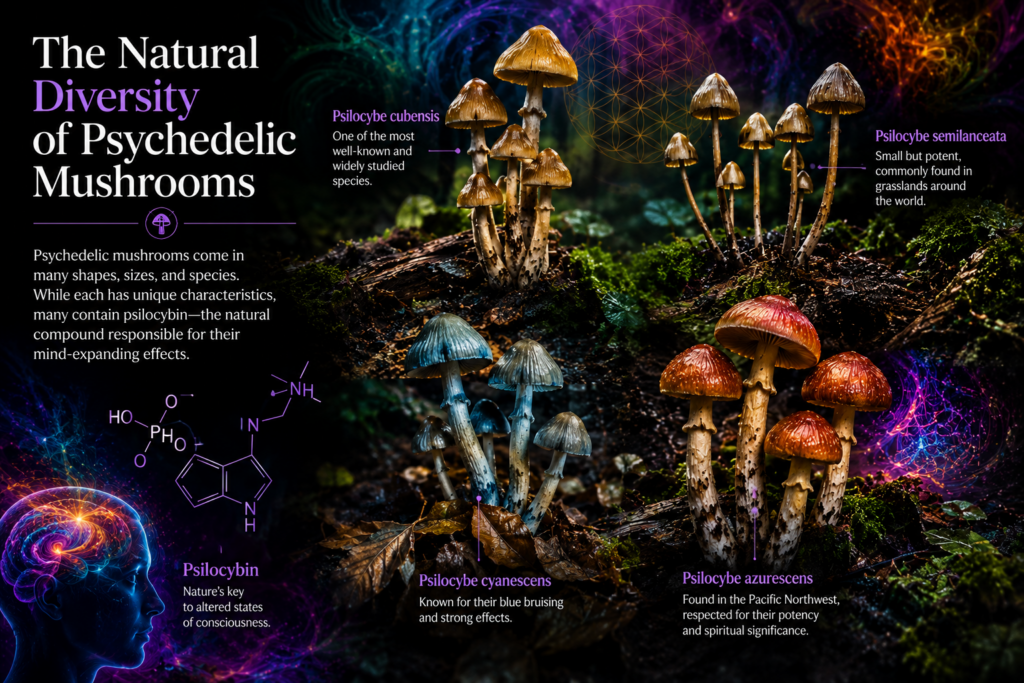
The primary category of mushrooms scientifically classified as psychedelic are those that contain the compound psilocybin. There are over 200 species of mushrooms in the Psilocybe genus that produce this compound .
When a person ingests a psilocybin-containing mushroom, the psilocybin is converted by the body into its active form, psilocin. This conversion happens through a process called dephosphorylation . Psilocin is the compound that is directly responsible for the psychedelic effects. It is structurally similar to the neurotransmitter serotonin and acts as a potent agonist at serotonin 2A (5-HT2A) receptors in the brain.
It is important to emphasize that the scientific study of psilocybin and its effects is conducted in highly controlled laboratory settings. Research in this area aims to understand the neurochemical and therapeutic potential of these compounds, not to provide guidance on their use.
The discussion of psilocybin-containing mushrooms in this article is purely for educational and definitional purposes and is not a guide to their identification or use.
A Different Category — Amanita and Non-Serotonergic Effects
It is a common misconception that all psychoactive mushrooms are psychedelic. A prominent example of a psychoactive but not psychedelic mushroom is Amanita muscaria. This iconic red-and-white-capped mushroom, often depicted in folklore and popular culture, contains psychoactive compounds, but they act on the brain in a completely different way than psilocybin.
The primary active compounds in Amanita muscaria are muscimol and ibotenic acid . Unlike psilocybin, which affects the serotonin system, muscimol is a potent agonist of GABAa receptors, the main inhibitory neurotransmitter system in the brain . Ibotenic acid, on the other hand, is an agonist of glutamate receptors, which are part of the brain’s primary excitatory system.
This fundamental difference in neurochemical mechanism means that the effects of Amanita muscaria are distinct from those of psilocybin-containing mushrooms. While both can alter consciousness, the subjective experiences and risk profiles are very different. The effects of muscimol are often described as sedative-hypnotic or deliriant, and can include confusion, agitation, and a dream-like state.
This is a stark contrast to the often-reported effects of psilocybin, which are more typically characterized by introspection, emotional release, and altered sensory perception. The GABAergic action of muscimol tends to depress the central nervous system, which can lead to a state more akin to delirium than the heightened state of awareness sometimes associated with classic psychedelics.
Because of these different active compounds, brain mechanisms, and risk profiles, it is scientifically incorrect to group Amanita muscaria with psilocybin-containing mushrooms. Doing so can be misleading and dangerous, as it ignores the critical differences in their pharmacology and potential toxicity. Amanita muscaria also has a higher risk of toxicity, and is related to deadly species like Amanita phalloides (the “Death Cap”) .
Psychedelic Mushrooms vs “Normal” Mushrooms
To further clarify what makes a mushroom psychedelic, it is helpful to compare them to other types of mushrooms that are more commonly encountered.
•Culinary Mushrooms: These are mushrooms that are cultivated or foraged for their flavor and nutritional value. Examples include shiitake, portobello, and chanterelle mushrooms. They do not contain psychoactive compounds and are consumed as food.
•Medicinal Mushrooms: This category includes mushrooms that are used for their health-promoting properties. Examples include Reishi, Lion’s Mane, and Turkey Tail. While they may contain bioactive compounds that can affect the body, they do not produce psychedelic or psychoactive effects in the scientific sense.
•Psychoactive Mushrooms: This is a broad category that includes any mushroom containing compounds that affect the central nervous system. As we have seen, this category includes both psychedelic (serotonergic) mushrooms like Psilocybe species and non-psychedelic psychoactive mushrooms like Amanita muscaria.
It is essential to understand that the vast majority of mushroom species in the world are neither psychedelic nor safe for human consumption. Many are poisonous and can cause severe illness or death if ingested. There are no simple visual cues to distinguish between edible, poisonous, and psychoactive mushrooms, which is why expert identification is crucial.
Why Misidentification Is Dangerous
The misidentification of wild mushrooms poses a significant and potentially fatal risk. Many species of poisonous mushrooms bear a striking resemblance to edible or psychoactive varieties, and even experienced mycologists can have difficulty distinguishing between them without laboratory analysis.
Ingesting a misidentified mushroom can lead to a range of severe health consequences, from gastrointestinal distress to liver failure, kidney failure, and death. For example, the deadly Amanita phalloides, or “Death Cap,” can be mistaken for edible species, and it contains potent toxins called amatoxins that can cause irreversible liver damage.
Similarly, some toxic Galerina species, which contain the same deadly amatoxins as the Death Cap, can be mistaken for psilocybin-containing mushrooms due to their similar size and brownish appearance. This makes foraging for any brown-capped mushroom in the wild an extremely risky activity without expert, laboratory-confirmed identification.
Even when a mushroom is correctly identified as psychoactive, there can be risks. The potency of psychoactive compounds can vary significantly from one mushroom to another, even within the same species. This variability makes it impossible to determine a safe or predictable dose from wild mushrooms.
For these reasons, this website does not provide any guidance on the identification, foraging, or cultivation of mushrooms. The risks associated with misidentification are simply too high. Any individual who suspects they have ingested a poisonous mushroom should seek immediate medical attention or contact a poison control center.
Legal and Cultural Context (Brief, Neutral Framing)
The legal status of psilocybin-containing mushrooms varies significantly around the world and is subject to change. Internationally, psilocybin and psilocin are listed as Schedule I drugs under the 1971 United Nations Convention on Psychotropic Substances . This classification is typically reserved for substances with a high potential for abuse and no accepted medical use.
In the United States, psilocybin is a Schedule I substance under the Controlled Substances Act, making its possession, sale, and use illegal at the federal level . However, there is a growing movement at the state and local levels to decriminalize or legalize psilocybin for therapeutic use. For example, Oregon and Colorado have created regulated programs for psilocybin services, and several cities have decriminalized the personal possession of psilocybin-containing mushrooms .
It is important to note that the legal status of these substances is often not aligned with the current state of scientific research. Despite their Schedule I classification, a growing body of evidence suggests that psilocybin may have therapeutic potential for treating a range of mental health conditions, such as depression and post-traumatic stress disorder (PTSD).
This has led to a re-evaluation of their legal status in some jurisdictions, and the U.S. Food and Drug Administration (FDA) has granted “breakthrough therapy” designation to psilocybin for the treatment of depression, which is intended to expedite the development and review of drugs that are intended to treat a serious condition .
This section is provided for informational purposes only and is not intended as legal advice. The legal landscape surrounding psychedelic mushrooms is complex and constantly evolving.
Educational Disclaimer
This content is for educational purposes only and is not intended to be a substitute for professional medical, psychological, legal, or identification advice. The information provided in this article is for general knowledge and informational purposes only, and does not constitute the practice of medicine, or other professional health care services, including the giving of medical advice.
Readers should not rely on the information contained in this article for diagnosing, treating, or managing any health or legal issues. If you have or suspect you have a medical problem, or if you have ingested or been exposed to a potentially toxic substance, please contact a qualified health care provider or your local poison control center immediately.