
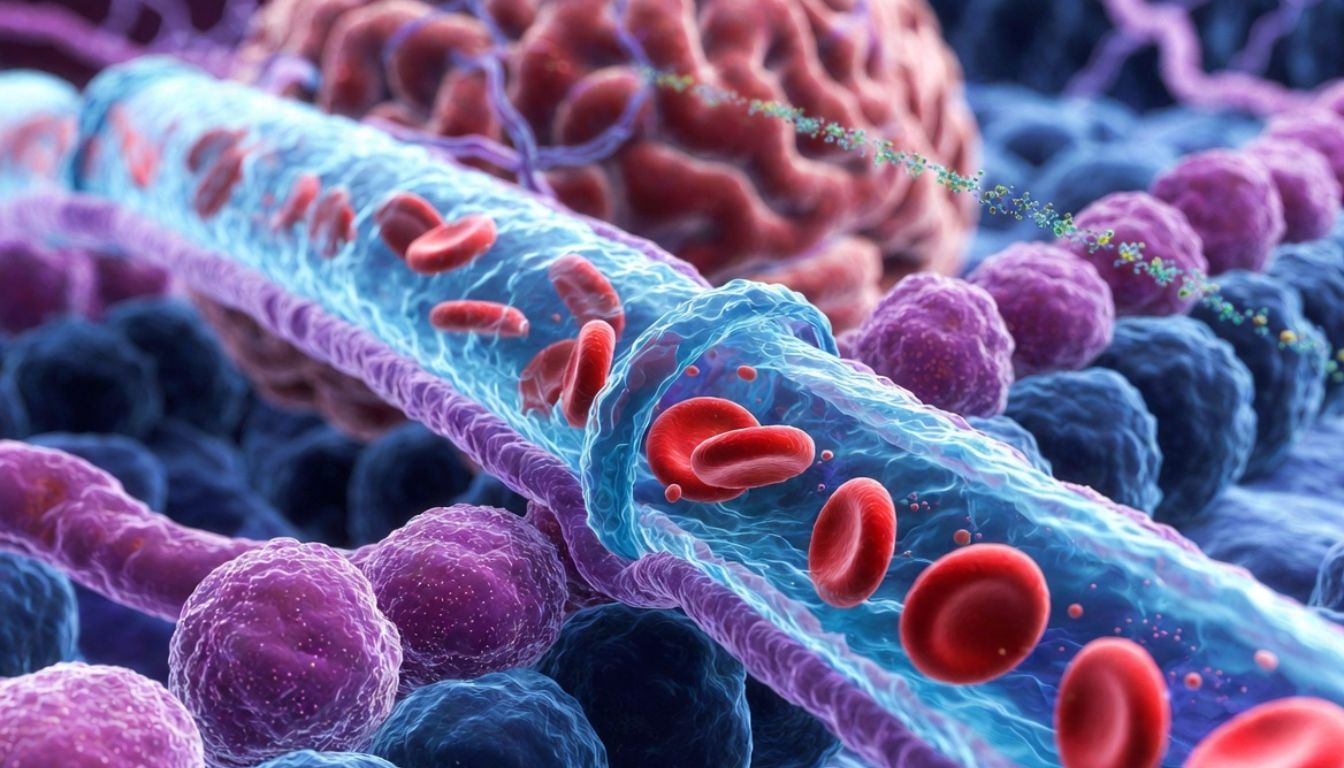
The blood–brain barrier (BBB) is a highly selective, semipermeable border of endothelial cells that prevents solutes in the circulating blood from non-selectively crossing into the extracellular fluid of the central nervous system (CNS) where neurons reside .
This intricate cellular system is a critical component of neuroprotection, meticulously regulating the passage of substances to maintain the delicate homeostasis required for optimal brain function. Consequently, its existence is fundamental to safeguarding the brain from toxins, pathogens, and other potentially harmful agents, while simultaneously facilitating the transport of essential nutrients and molecules.
The significance of the blood–brain barrier extends profoundly into the fields of neuroscience and pharmacology, where it presents both a protective asset and a formidable challenge. Therefore, understanding its complex structure and multifaceted functions is paramount for developing effective therapeutic strategies for a host of neurological and psychiatric disorders.
This article provides a comprehensive, evidence-based overview of the blood–brain barrier, focusing exclusively on its biological structure, physiological function, and relevance in scientific research. It will explore the cellular architecture of the barrier, the mechanisms by which substances traverse it, and its role in both health and disease.
Furthermore, the article will address its pharmacological implications, particularly concerning the delivery of therapeutic agents to the brain, and clarify common misconceptions. The information presented herein is intended for educational purposes, drawing upon established scientific literature to deliver a detailed and neutral account of this vital biological system.
What Is the Blood–Brain Barrier?
The blood–brain barrier is fundamentally a biological partition between the body’s circulatory system and the central nervous system. Its primary role is to provide a stable and protected microenvironment for the brain. This is achieved through a highly regulated system of cellular structures that form a physical and metabolic barrier.
The core of the BBB is composed of specialized endothelial cells that line the brain’s capillaries. Unlike endothelial cells in other parts of the body, these are fused together by complex protein structures known as tight junctions, which severely restrict the passive diffusion of substances from the blood into the brain .
This structural arrangement results in the BBB’s hallmark feature: selective permeability. While it effectively blocks the entry of most large molecules, toxins, and potential pathogens, it is not an impenetrable wall. In fact, the barrier is equipped with a sophisticated array of transport systems that facilitate the passage of essential compounds.
These include carrier-mediated transport for nutrients like glucose and amino acids, and receptor-mediated transcytosis for larger molecules such as insulin and transferrin. Consequently, the BBB maintains a delicate balance, ensuring the brain receives the necessary metabolic substrates while being shielded from harmful elements .
Why the Blood–Brain Barrier Exists
The evolution of the blood–brain barrier is a testament to the critical need for a protected and stable neural environment. Its existence provides a significant evolutionary advantage by shielding the central nervous system from the fluctuating composition of the blood.
The brain’s intricate neural signaling processes are highly sensitive to chemical changes, and even minor alterations in the extracellular fluid can disrupt neuronal function. Therefore, the BBB’s primary purpose is to maintain a constant and optimal environment for the brain’s cells, a concept known as CNS homeostasis.
One of the most crucial functions of the BBB is to prevent toxins and pathogens from entering the brain. The bloodstream can carry a wide range of neurotoxic substances, both endogenous and exogenous, which could have devastating effects on neural tissue. By restricting the passage of these harmful agents, the BBB acts as a frontline defense mechanism.
Additionally, the barrier plays a key role in separating the brain’s immune system from that of the rest of the body. While the brain has its own specialized immune cells, the entry of peripheral immune cells is tightly regulated to prevent an inflammatory response that could damage delicate neural circuits. This immune separation is vital for preventing neuroinflammation, a condition implicated in numerous neurological disorders .
Structure of the Blood–Brain Barrier
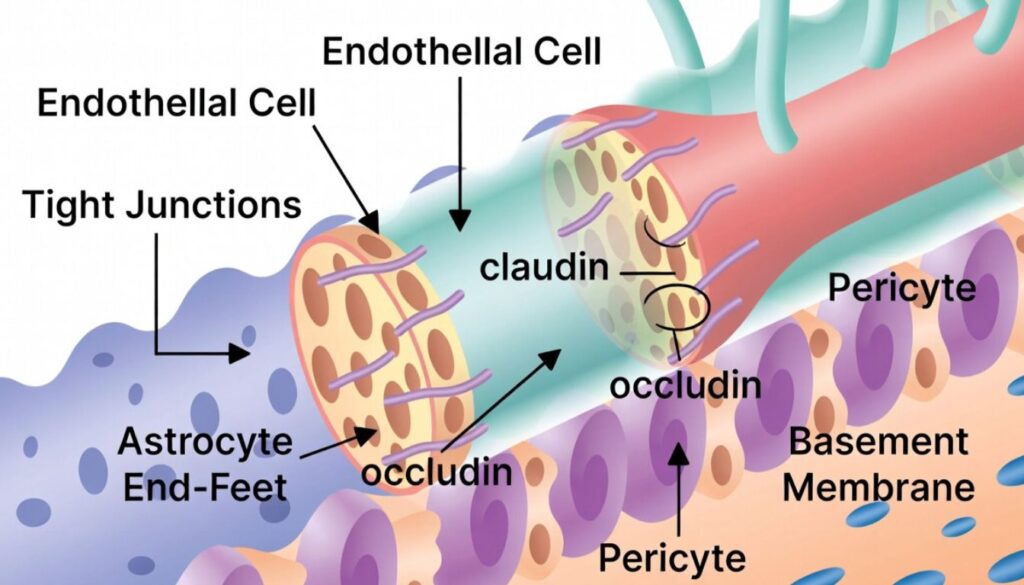
The blood–brain barrier is a complex, multicellular structure, often referred to as the neurovascular unit (NVU). This unit comprises several key cellular and acellular components that work in concert to maintain the barrier’s integrity and function. The primary components include:
•Endothelial Cells: These are the principal cells of the BBB, forming the wall of the brain capillaries. They are characterized by the presence of tight junctions, a low rate of pinocytosis (the engulfing of small particles), and a lack of fenestrations (pores), all of which contribute to the barrier’s low permeability.
•Tight Junctions: These are complex protein structures that seal the space between adjacent endothelial cells, effectively creating a continuous cellular barrier. Key proteins involved in forming these junctions include claudins, occludin, and junctional adhesion molecules (JAMs). The integrity of these junctions is a primary determinant of BBB permeability .
•Astrocyte End-Feet: Astrocytes, a type of glial cell, extend processes that terminate in “end-feet” that almost completely envelop the brain capillaries. These astrocyte end-feet are crucial for the induction and maintenance of the BBB properties in the endothelial cells.
•Pericytes: These cells are embedded within the basement membrane of the capillaries and share it with the endothelial cells. Pericytes are contractile cells that play a role in regulating capillary blood flow, and they are also involved in the formation and maintenance of the BBB, contributing to the stability of the tight junctions.
•Basement Membrane: This is a layer of extracellular matrix that surrounds the endothelial cells and pericytes, providing structural support to the capillary. It is composed of proteins like collagen, laminin, and fibronectin, and it also plays a role in regulating the passage of molecules.
Together, these components form a dynamic and interactive unit that not only restricts but also actively regulates the exchange of substances between the blood and the brain.
How Substances Cross the Blood–Brain Barrier
The transport of substances across the blood–brain barrier is a highly regulated process that occurs through several distinct mechanisms. These can be broadly categorized into passive and active transport systems. The ability of a substance to cross the BBB depends on its physicochemical properties, such as lipid solubility, size, and charge, as well as the presence of specific transporters.
Passive Diffusion: This is the primary mechanism for the entry of small, lipid-soluble molecules into the brain. Substances that are highly lipophilic can dissolve in the lipid membranes of the endothelial cells and diffuse across the barrier down their concentration gradient. This process does not require energy. Many psychoactive drugs cross the BBB via this route due to their high lipid solubility .
Carrier-Mediated Transport: This form of transport involves specific protein carriers embedded in the endothelial cell membranes. These carriers bind to specific molecules, such as glucose, amino acids, and nucleosides, and facilitate their transport across the BBB. This process can be either passive (facilitated diffusion) or active, requiring energy. These systems are essential for supplying the brain with the necessary nutrients for its high metabolic activity .
Receptor-Mediated Transcytosis (RMT): This is a more complex mechanism that allows for the transport of larger molecules, such as peptides and proteins, across the BBB. In RMT, the molecule binds to a specific receptor on the surface of the endothelial cell, which then triggers the formation of a vesicle that transports the molecule across the cell. This process is highly specific and is used for the transport of essential molecules like insulin and transferrin.
Adsorptive-Mediated Transcytosis: This is a non-specific form of transcytosis that is triggered by the electrostatic interaction between a positively charged substance and the negatively charged surface of the endothelial cell membrane. This mechanism is less common than RMT but can be a pathway for the entry of certain peptides and proteins into the brain.
The Blood–Brain Barrier and Neurotransmitters
The blood–brain barrier plays a critical role in regulating the levels of neurotransmitters in the central nervous system. Most neurotransmitters, such as serotonin and dopamine, are unable to cross the BBB from the peripheral circulation. This is a crucial protective mechanism, as fluctuations in peripheral neurotransmitter levels, which can occur in response to various physiological events, would otherwise disrupt the precise balance of neurotransmission in the brain.
Instead of transporting the neurotransmitters themselves, the BBB is equipped with specific transport systems for their precursors. For example, the amino acid tryptophan, which is the precursor for serotonin, is transported across the BBB by a carrier-mediated transport system for large neutral amino acids .
Similarly, L-DOPA, the precursor for dopamine, can cross the BBB, while dopamine itself cannot. This allows the brain to synthesize its own neurotransmitters in a controlled manner, ensuring that their levels are tightly regulated within the CNS.
The inability of most neurotransmitters to cross the BBB has significant implications for pharmacology. For instance, in the treatment of Parkinson’s disease, which is characterized by a deficiency of dopamine in the brain, patients are treated with L-DOPA rather than dopamine, as L-DOPA can cross the BBB and be converted to dopamine in the brain. This highlights the importance of understanding the transport mechanisms of the BBB in the development of drugs that target the central nervous system.
The regulation of precursor transport is also a key area of research, as it has implications for a variety of neurological and psychiatric conditions. For example, the transport of tryptophan across the BBB can influence the synthesis of serotonin, a neurotransmitter that is heavily implicated in mood regulation and is a target for many antidepressant medications.
The intricate relationship between the BBB and neurotransmitter systems underscores the barrier’s central role in maintaining brain health and function. The 5-HT2A receptor, a key receptor for serotonin, is a major focus of research in this area [Internal link: 5-HT2A Receptor].
The Blood–Brain Barrier in Psychiatric and Neurological Research
Dysfunction of the blood–brain barrier is increasingly recognized as a key factor in the pathophysiology of a wide range of psychiatric and neurological disorders. Research suggests that a compromised BBB can contribute to neuroinflammation, neurodegeneration, and altered neurotransmission, all of which are implicated in the development and progression of these conditions.
In neuroinflammation, a breakdown of the BBB can allow for the infiltration of peripheral immune cells and inflammatory molecules into the brain, triggering an inflammatory cascade that can damage neural tissue. This process is thought to play a role in conditions such as multiple sclerosis, where the immune system attacks the myelin sheath that insulates nerve fibers. Evidence indicates that in multiple sclerosis, the BBB becomes more permeable, allowing immune cells to cross into the CNS and cause inflammation and demyelination .
In Alzheimer’s disease, research suggests that BBB dysfunction occurs early in the disease process and contributes to the accumulation of amyloid-beta plaques, a hallmark of the disease. A compromised BBB may impair the clearance of amyloid-beta from the brain and allow for the entry of neurotoxic substances, exacerbating the neurodegenerative process . Findings remain under investigation, but the link between BBB breakdown and Alzheimer’s is a major area of current research.
In the context of psychiatric disorders such as depression, evidence is emerging that suggests a role for BBB dysfunction. Some studies have found increased BBB permeability in individuals with major depressive disorder, which may be linked to the inflammatory processes that are often observed in this condition. A compromised BBB could allow for the entry of inflammatory cytokines into the brain, which can disrupt neurotransmitter systems and contribute to the symptoms of depression. Research in this area is ongoing, but it highlights the potential for the BBB to be a novel therapeutic target for psychiatric disorders.
The Blood–Brain Barrier and Psychoactive Compounds
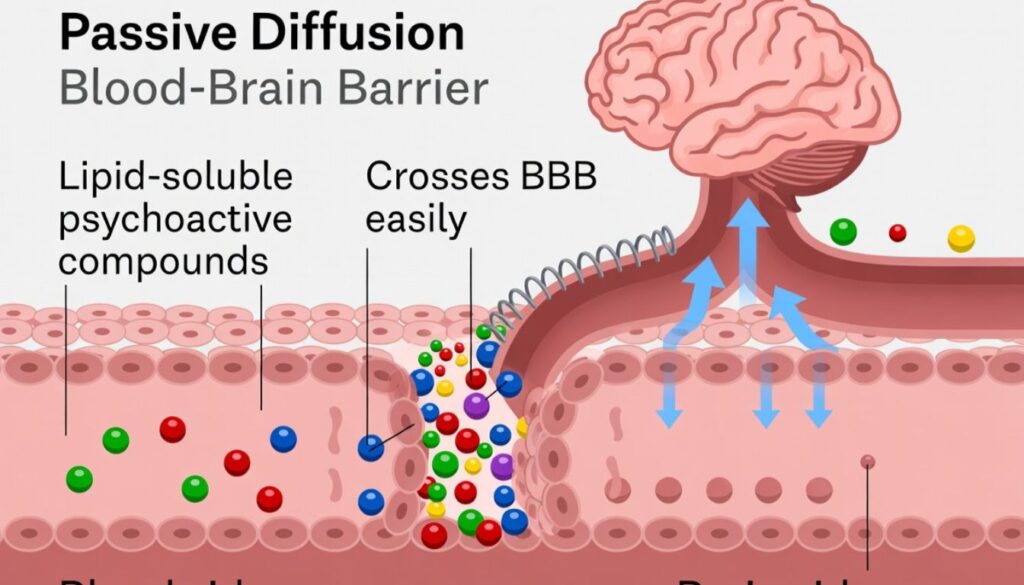
The ability of psychoactive compounds to exert their effects on the central nervous system is largely dependent on their ability to cross the blood–brain barrier. The physicochemical properties of a drug, particularly its lipid solubility, are a key determinant of its ability to penetrate the BBB. Many psychoactive substances, such as alcohol and nicotine, are small, lipid-soluble molecules that can readily diffuse across the BBB.
Once a psychoactive compound has crossed the BBB, it can interact with specific receptors in the brain to produce its effects. For example, psilocybin, the active compound in psychedelic mushrooms, is rapidly converted to psilocin in the body.
Psilocin is a highly lipid-soluble molecule that can cross the BBB and bind to serotonin receptors, particularly the 5-HT2A receptor, to produce its characteristic psychedelic effects [Internal link: Psilocybin and Psilocin]. The study of how these compounds interact with brain networks, such as the default mode network, is a growing area of research [Internal link: Default Mode Network].
The importance of the BBB in pharmacology cannot be overstated. The development of drugs that target the central nervous system is a major challenge, as many potentially therapeutic compounds are unable to cross the BBB in sufficient concentrations to be effective.
Researchers are exploring a variety of strategies to overcome this challenge, including the development of drugs with increased lipid solubility, the use of carrier-mediated transport systems, and the development of novel drug delivery systems that can bypass the BBB.
The study of how psychoactive compounds cross the BBB provides valuable insights into the mechanisms of drug transport and can inform the design of more effective neurotherapeutics
Common Misconceptions About the Blood–Brain Barrier
There are several common misconceptions about the blood–brain barrier that can lead to a misunderstanding of its function and significance. It is important to address these myths with scientific explanations.
•“Nothing can cross the blood–brain barrier.” This is incorrect. As discussed, the BBB is selectively permeable, not impermeable. It is equipped with a variety of transport systems that allow for the passage of essential nutrients and other molecules. If nothing could cross the BBB, the brain would be unable to function.
•“The BBB can be easily bypassed.” While there are strategies to bypass the BBB for therapeutic purposes, this is a complex and challenging process. The BBB is a robust and highly regulated barrier, and bypassing it requires sophisticated techniques. It is not something that can be easily achieved.
•“Supplements can ‘open’ the BBB safely.” There is no scientific evidence to support the claim that dietary supplements can safely and effectively ‘open’ the BBB. The integrity of the BBB is crucial for brain health, and any substance that disrupts it could have serious and potentially harmful consequences.
•“It is a solid wall.” The BBB is not a solid, static structure. It is a dynamic, living barrier composed of a complex arrangement of cells that are in constant communication with each other and with the surrounding neural environment. Its permeability can be modulated in response to various physiological and pathological signals.
Limitations and Evolving Research
While our understanding of the blood–brain barrier has advanced significantly, there are still many limitations and unanswered questions. The BBB is a highly complex and dynamic system, and its properties can vary between different regions of the brain and can change with age and in response to various physiological and pathological conditions.
One area of active research is the variability in BBB permeability. The permeability of the BBB is not uniform throughout the brain, and there are certain regions, known as circumventricular organs, where the BBB is more permeable. Understanding the reasons for this regional variability could provide insights into the function of these brain regions and could have implications for drug delivery.
Another important area of research is the effect of aging on the BBB. Evidence suggests that the integrity of the BBB can decline with age, leading to increased permeability. This age-related BBB dysfunction may contribute to the cognitive decline that is often seen in older adults and may increase the risk of developing neurodegenerative diseases. The study of how the BBB changes with age is crucial for understanding the aging process and for developing strategies to maintain brain health in later life .
The effects of inflammation on the BBB are also a major focus of research. Inflammation, both systemic and within the central nervous system, can disrupt the integrity of the BBB and increase its permeability. This can have a wide range of consequences, from exacerbating the damage caused by a stroke to contributing to the symptoms of depression. Understanding the mechanisms by which inflammation affects the BBB could lead to new therapeutic strategies for a variety of neurological and psychiatric disorders.
Emerging imaging techniques are providing new opportunities to study the BBB in vivo. Techniques such as dynamic contrast-enhanced magnetic resonance imaging (DCE-MRI) and positron emission tomography (PET) are allowing researchers to visualize and quantify BBB permeability in real-time. These techniques are providing new insights into the function of the BBB in health and disease and are helping to accelerate the development of new drugs that can cross the BBB.
Conclusion
The blood–brain barrier is a vital biological system that plays a central role in maintaining the health and function of the central nervous system. Its intricate structure and sophisticated transport systems allow it to meticulously regulate the exchange of substances between the blood and the brain, providing a stable and protected microenvironment for neural activity. The scientific complexity of the BBB is immense, and research continues to uncover new details about its structure, function, and regulation.
The importance of the BBB in neuroscience and pharmacology cannot be overstated. It is a key factor in the pathophysiology of a wide range of neurological and psychiatric disorders, and it presents a major challenge for the development of drugs that target the central nervous system. A deeper understanding of the BBB is essential for developing effective therapeutic strategies for these conditions.
As research in this field continues to evolve, it is likely that the BBB will become an increasingly important target for therapeutic intervention. The ongoing exploration of the BBB’s role in health and disease promises to yield new insights that will have a profound impact on the future of neuroscience and medicine.
Disclaimer
This article is for educational and informational purposes only and does not constitute medical, psychological, or legal advice.
[Internal link: Neuroplasticity][Internal link: Contraindications & Interactions Hub]